





Fostering Professionals to BlendCultures and Create of New Art
[Trend] NEXT Project to Foster Cultural Exchange Experts - Operating an Academy and Supporting Research Activities for International Cultural Exchange
Dispatch State of Professionals for International Cultural Exchange in 2013
If international cultural exchange of the past referred to promotion of superior domestic culture and by extension, Korea, today, it signals the natural fusion of the culture that is shared bilaterally between two countries, as well as the new opportunities for development in art and culture that might arise as a result. Hallyu, or the Korean Wave , in particular, has exposed Korea’s pop cultural scene to foreign markets, making it exponentially more famous, which has brought with it its own set of concerns.
Korea’s performing arts, visual arts, literature, film and pop culture have much to learn from interacting with those of other countries’, and through heightened exchange with many countries, they may come to be on par with the quality of those in the global market, and more. Thus, it is such activitieson an international level that are important, which leads us ultimately to the people who plan such things and execute them. It is urgent that Korea trains professionals who have the knowledge and skills for international cultural exchange. Experts in this field include people who plan and execute these cultural exchange programs, and those who earn the official title of expert have managed such international projects either as part of an art organization or on a freelance basis, according to the interests of the group or of the individual.
|
|
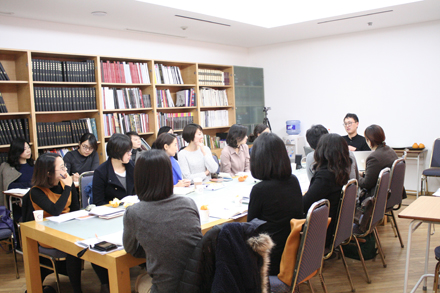
| ▲ Samuso’s “Cultural Exchange on Visual and Performance Arts Academy - 2013 Art Sonje Curatorial Platform” |
The Current Status of the International Cultural Exchange Academy in 2013
In 2013, the Korea Arts Management Service and the Ministry of Culture began the “NEXT Project to Cultivate Professionals for International Cultural Exchange,” in recognition of the greater trend of nations to collaborate on a cultural and artistic level, and the on the ground level need for trained professionals for such activities. A cornerstone of the NEXT project is to operate the NEXT International Cultural Exchange Academy, and NEXT STEP, of which the main objective is to support research on international cultural exchange. The final aim of such projects is to train specialists with international savvy and business skills, from a pool of candidates including experienced planners of international cultural exchange projects and others attempting to break into the industry.
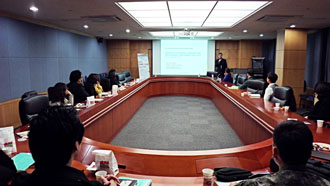
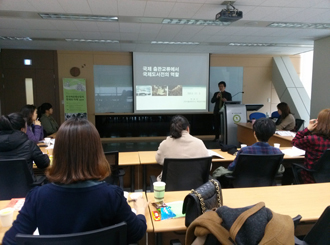
First, the NEXT International Cultural Exchange Academy project is designed to share the knowhow of organizations currently engaged in cultural exchange, and to raise specialists needed in the field. The Academy has offered courses in performance arts, visual arts, literature and general arts, operated nine programs with a total of nine participating organizations, and graduated around 200 members, who span across various fields and backgrounds. The program was well received, offering a chance to see both the real need for trained experts in the field of cultural exchange, as well as the willingness of people to meet such demands.
|
|
|
| L) Korean Cultural Institute’s International Cultural Exchange Academy R) Institute SAII’s “Publishing Systems around the World and a Strategy for Expansion Overseas” | |
| Type | Name of Institution | Name of Project | Date | ||
| General International Cultural Exchange |
1 | Civil servants | Korean Cultural Institute | International Cultural Exchange Academy | 2013. 11. 6~2014. 1. 14 (total 12 classes/ 26 hours) |
| 2 | General public | Daejeon Culture and Arts Foundation | International Exchange Academy for a Global Daejeon | 2014. 1. 13~2. 22 (total 14 classes / 28 hours) | |
| Literature | 3 | Introduction | WowbookCulture and Art Center | The Korean Book and Cultural Industry’s Present and Future | 2013. 11. 16~12. 4 (total 12classes/ 24 hours) |
| 4 | Intensive | Moonji Cultural Institute SAII | Publishing system of various countries and the strategy for Korean literature to expand overseas | 2014. 1. 10~1. 12 (total 6 classes/16 hours) | |
| Performing Arts | 5 | Introduction | Performing Arts Management Association of Korea | International Cultural Exchange Academy | 2014. 9. 2~11. 25 (total 14 classes/ 28 hours) |
| 6 | Intensive | The International Dance Council, UNESCO, Korean branch | Developing the Art Organization’s Resilience and Sustainability for International Exchange and Expansion into International Market | 2013. 10. 16~12. 12 (total 11 classes/ 22 hours) | |
| Visual Arts | 7 | Introduction | Nonprofit Art Spaces Network | Program to Foster International Cultural Exchange Planners | 2014. 3. 8~5. 3 (total 15 classes/ 37 hours) |
| 8 | Intensive | East Asian Arts and Culture Research Institute | Cultural Strategy to Globalize the Korean Wave: Intensive Academy for Global Contemporary Arts Specialists | 2013. 10. 19~2014. 2. 8 (total 23 classes/ 24 hours) | |
| 9 | Intensive | Samuso | Academy forInternational Exchange ofVisual Arts - 2013 Art Sonje Curatorial Platform | 2013. 10. 19~2014.2.8 (total 11 classes / 45 hours) | |
2013 NEXT STEP Support of International Cultural Exchange and Resultant Research
The NEXT STEP’s support of research on international cultural exchange is a rather supply-focused approach project, attempting to improve the Academy and strengthen the networks between the professional staff dispatched by the Academy. It will help its members create new projects based off the networks built among the personnel, and the ensuing research that’s jointly led by its staff. Such process-driven assistance will aid participants to voluntarily strength entheir interest area and form a base from which they may continue to build competence in their chosen fields. The NEXT STEP program will select a total of four groups for support, through a public contest that will be held mid-March 2014.
| Joint Learning Program | Group-based Project Development Meeting | |
| Goals |
Customized education program to enhance competence of professional staff |
Subsidized meeting of members for project planning of international cultural exchange |
| Selection Methods |
Selected through public contest, which will examine study plan and interview |
Selected through public competition, which will examine business plan, research plan and interview |
| Participants |
Learning group will consist of minimum five to maximum twelve members (freely decided as seen fit by members) |
Project research group will consist of minimum four to maximum eight members (freely decided as seen fit by members) |
| Types of Support |
1) Subsidy: maximum 2,000,000 won per group, to cover costs of managing each study meet 2) Support method: subsidize activity costs and provide consulting help ◎ Subsidy for activity costs: 50% given after contract and before the activity starts, and remainder paid after interim report ※ Subsidy usage: for rent, instructor hiring costs, process costs and management costs ◎ Will provide consulting advice to improve efficacy of study groups |
1) Subsidy: maximum 2,000,000 won, per group to cover the project’s research costs 2) Support method: subsidize activity costs and provide consulting help ◎ Subsidy for activity costs: 50% given after contract and before the activity starts, and remainder paid after interim report ※ Subsidy usage: for rent, expert hiring costs, process costs and management costs ◎ Will provide consulting advice to develop and actualize the research |
| Shared Results |
◎ Must hand in report of results ◎ Result report must detail the process and result of activities, in form chosen freely by participants ◎ After end of project, results will be shared and presented to discern the most outstanding case examples |
◎ Must hand in report of results ◎ Result report must detail the process and result of activities, in form chosen freely by participants ◎ After end of project, results will be shared and presented to discern the most outstanding case examples |
The NEXT International Cultural Exchange program to cultivate experts is in its early beginnings. With various education programs, field support, and entry support for those attempting to enter into international cultural exchange, the NEXT program will train professionals and further expand its business in 2014.
 PREV
PREV
.JPG)
.jpg)
.jpg)
.jpg)
.jpg)












.jpg','If international cultural exchange of the past ref..');)


