





’’Artist Incubation’’ of the inside of the performance ecology in Seoul
[Festivals/Markets]UK-Korea Arts Exchange Programme Review
It’’s been just over a week since I returned from Seoul where I’’d been participating in UK-Korea Arts Exchange Programme. The Programme is a partnership between the Korea Arts Management Service (KAMS) and The British Council. It follows on from previous successful exchange programmes run by KAMS with other international partners in Finland, Australia and Poland.
I was one of three UK producers selected to participate, alongside Morag Deyes, Artistic Director of Dance Base in Edinburgh, and Kate Scanlan, an independent dance producer based in London. Our visit took the form of an intensive (and it was intensive!) schedule of meetings, site visits, performances and talks. It was all built around the Performing Arts Market in Seoul programme, which helpfully broadened the international context for our discussions. And in particular, it was valuable to see the fruits of previous exchange programmes – notably new collaborations between Finnish and Korean artists.
|
|
| From left to right Morag Deyes, Kate Scanlan, Korean staff and Tanuja Amarasuriya |
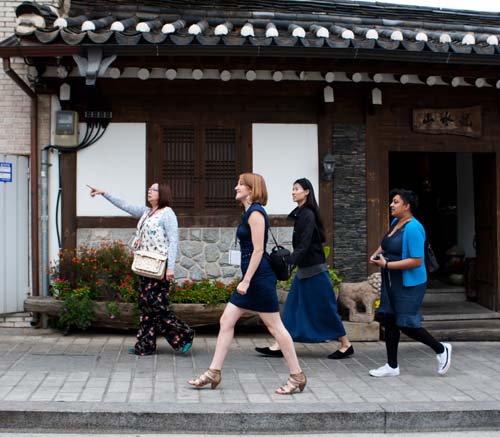
The focus of this Korea-UK Connection was "Artist Incubation", or what we might more commonly call "artist development" in the UK. Defining "artist development" is not an easy thing to do, as of course, all artists are different; but in a nutshell, it’’s about supporting artists to hone their skills and vision, and to understand the industry, audiences and communities they work with. It’’s an area of producing that’’s quite well established in the UK, with organisations like Theatre Bristol, where I work, specialising in the field. For me, the starting point with artist development is always the artist, so I found it interesting that so many of the meetings we had scheduled were to see venues rather than performances. But then, Seoul has such spectacular spaces! It was incredible to see the facilities that have been invested in over the last decade: the Seoul Art Spaces, Doosan Arts Centre, HanPAC, Seoul Theatre Centre, Namsan Arts Centre… walking into these theatres and studios immediately made the artist in me want to create. It’’s extraordinary to think that all these excellent spaces are in one city, and that there are so many more art centres in Seoul beyond those.
|
|
| |
| 2012 UK-Korea Arts Exchange Programme |
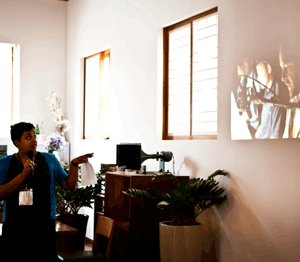
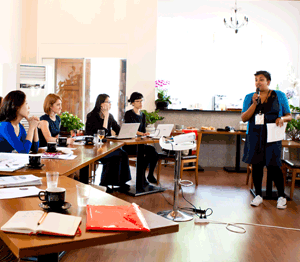
With access to this level of rehearsal and production facility, it’’s easy to see why the technical skills of the Korean performers were generally so impressive. We didn’’t see as much work as I’’d have liked to, but technical prowess was something of note in almost all the Korean work we saw. High spec rehearsal spaces are hard to access in the UK and seeing things like the massive lighting rig in the small studio at Doosan Arts made me hungry to see what an emergent UK artist might learn from the opportunity to play in a space like that.
Aside from the bricks and mortar structures, I was also struck by how rigid the structures of artist development schemes seem to be in Seoul. In the UK, artist development is rooted in building relationships. It often involves producers collaborating with artists, delving into conceptual ideas and the creative process together to unearth it, reflect on it and interrogate it. Of course this is a sensitive process – it needs to be personal and built on trust. Conversely, it seemed that in Korea, development frameworks were much more formally pre-set, and artists were given little opportunity to personalise incubation schemes around their individual practices. It was only at Namsan Arts Centre where it seemed the venue dramaturgs might respond to the resident artists’’ individual needs, as opposed to the artist always responding to the predetermined training or process.
It’’s interesting to see this more formal, academic approach being prevalent even outside academic contexts. I wonder if this derives from something cultural? Whilst in Seoul, we were hosted with extraordinary generosity and this gentle polite kindness seemed to seep through all aspects of the social and professional interactions we had. I wonder if this social grace leads to some reluctance to ask questions of artistic ideas and process too?
|
|
| Seungyeop LEE ((Professor of Arts Management, Korean National University of Arts) and Tanuja Amarasuriya |

It was an incredible privilege to meet my Korean colleagues and be given this insight into the performance ecology in Seoul. It was a huge amount to take in, and the multiple observations and opportunities are still bubbling to the surface in my mind. There is so much potential here – for exchange and dialogue. Exciting times ahead.
Related Links
| 2012 UK-Korea Arts Exchange Programme page http://blog.britishcouncil.or.kr/1283
* photographed by Hyeonjun LEE
 PREV
PREV
.JPG)
.jpg)
.jpg)
.jpg)
.jpg)












.gif','It’s been just over a week since I returned from S..');)


