





Music without Borders, OneBeatSM
[Festivals/Markets] OneBeatSM
Last September, a cool fall was coming after a hot summer. At that time, I participated in the OneBeat project held in the United States as a gayageum player. OneBeat is a musical project organized and supported by the Bureau of Educational and Cultural Affairs (ECA) of the United States Department of State and planned by Bang on a Can and Found Sound Nation. This two-year project is worth 1.36 billion won. In 2012, the first year of the project, everyone was attracted by the very fact that young musicians from 21 countries had gathered together in one place regardless of their genres. The major goal of OneBeat is to discuss how music will be able to positively influence local communities and the entire world. To achieve this goal, despite the fact that it was during the critical period before the presidential election, the US government has prepared this big event under the banner of "musicians’’ people-to-people diplomacy," in an attempt to foster new music.
The 32 fellows (participants of OneBeat) were chosen from more than 900 applicants from about 40 countries, regardless of their genre (e.g. folk music, jazz, rock, traditional music, hip-hop, experimental music, electronic music, etc.). They were all young musicians with their own philosophy and principles regarding music and society. The seats for each performance, which played the fellows’’ music created with their endless affection for society, were all sold out. It was a large-scale, month-long music festival where a variety of genres met together vibrantly and tore down the wall between them.
|
|
| Video introducing the festival Go |
A Musical Project Enabled by Musicians
Three co-directors planned and led this project. They are all musicians in their mid-30’’s, full of enthusiasm and hope. In addition, the production managers, planners, coordinators, tour mangers and video producers who work together throughout the project period are also musicians. That is why there weren’’t any technical or physical difficulties during the entire process of creating and performing music, a process which encompassed workshops, brainstorming, rehearsals, recording, performances and post-production. Moreover, during the project period, even the little details of the participants’’ everyday life such as laundry, telecommunication, food, transportation and leisure activities were also designed to consider the characteristics of musicians pursuing freedom and those of the younger generation always wanting to be active. Such details also helped create a synergy with the fellows’’ musical activities.
Natural and Free Musical Activities; Residency
For the first two weeks of the project, the fellows stayed at the Atlantic Center for the Arts (ACA) located in New Smyrna Beach in the central area of Florida. ACA is in a beautiful jungle where lizards and sometimes, even armadillos appear, and it has housing units for the fellows and studios for all of the arts including music (recording), dance, theater, sculpture, painting and literature. It also has a dining room, a digital media studio and a library which could also be used as another recording studio. Freely using these facilities, the fellows were about to begin their musical journey full of hope.
For the first few days, we concentrated on getting to know each other. We became close to each together very easily thanks to the project’’s diverse programs such as a sound workshop which involved us giving our names using gestures and sounds and a program which randomly formed ensembles and had them perform together. Before we got to know each other, we had already started several diverse musical activities. During the project, we rearranged existing songs that each of us had already composed, made new music together and created new music using our country’’s tradition. Such experiments helped us create music. Each of us marked out practicing and recording places on the huge shared timetable, making our individual schedules. In every space on the campus of ACA, including the forest, the fellows continued their rehearsals and recording from early in the morning till late at night, to the point that everyone regarded 24 hours a day as insufficient for what we wanted to achieve. Indeed, the enthusiasm of OneBeat towards new music remained intact all the time, day and night.
|
|
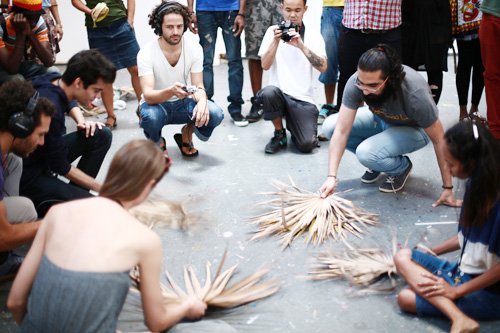
| The mission given on the first day of OneBeat: making music with elements of nature |
I mainly worked in three teams. The first one was a quartet randomly formed by lots. Its members were from India, the Middle East, the United States and Korea and each of us played our country’’s traditional music. The second team in which I participated in was a duet with a Lebanese singer-songwriter playing the oud. My last team was a duet with a Polish electronic musician. A harmony of the fast rhythm of country music and the traditional beat of Indian and Korean music, of the Korean traditional pentatonic scale and the Middle Eastern Hijaz scale and of analogue electronic sound and improvised gayageum tunes that mimicked the sounds of nature… In sum, it was so-called "fusion world music." Looking back, all of these collaborative performances constituted a very precious and helpful experience for everyone. That may be because the fellows collaborated by respecting each other’’s traditions, without any discrimination.
Since not only its fellows but also its directors and staff are all musicians, OneBeat is a project in which about 45 musicians participate. The number of songs that were created during the two-week residency period and that were played on the stage and recorded throughout the project period would be as many as 30 or 40. Adding to this improvised jam sessions and recordings that weren’’t played on the stage, the total number of songs would be enormous. These new songs from OneBeat that were born thanks to the young musicians’’ dreams and enthusiasm were arranged and modified through recording and tour performances. As time went by during the project period, these songs became stronger and more complete.
Ensembles and Workshops with Virtuosos; Collaboration with Artists
Another element of OneBeat that fascinated the fellows was the occasion to participate in workshops, lectures and ensembles with invited musicians. This collaborative work, which was carried out during the two-week residency period at the beginning of the project, focused on workshops, recording and master classes. Such collaboration continued during the tour performances that took place during the last two weeks. During their residency period, the fellows had an opportunity to stay at ACA with world-renowned artists based in New York including Pauline Oliveros who was a central figure in the development of electronic art music, Ione who is a New York Times bestselling playwright studying the world of dreams, Dave Douglas who is a virtuoso of improvised jazz performances, an educator and a trumpeter, Mark Stewart who is a guitarist for the Bang on a Can All-Stars and a multi-instrumentalist and Dafnis Prieto who is a Cuban drummer who uses innovative techniques. The performances and workshops shared with these artists were designed to embrace a variety of genres, for the sake of the fellows. Under these circumstances, although they were not required to participate in this joint program, almost all of the fellows and staff contributed to it as long as their schedule allowed them to do so. Consequently, the participants were able to share their views, music and energy. In particular, after each workshop, they connected the songs especially created for the competition to their own music. This exercise provided the driving force behind the original new music created during the OneBeat project period.
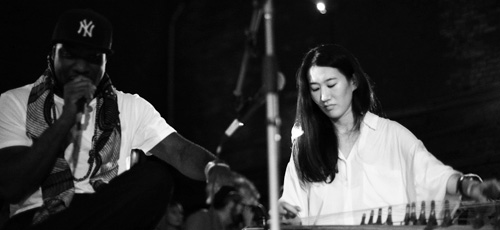
During the two-week tour, we traveled from Florida to New York. This tour also gave us opportunities to perform with the artists from each region where we were staying. Before leaving for the US, we had been given an email containing information on the musicians with whom we would collaborate. This email had provided us with sufficient information on each artist and his or her music. To be honest, I wondered what these artists and I would have in common. However, the on-site collaboration with them allowed me to unexpectedly create great performances on the stage and thus to feel the unlimited power and potential of music absorbing different genres. Such collaborative work brought about different positive results. First, it once again enabled the fellows to take a closer look at America’’s authentic culture hidden behind the facade of pop music and Hollywood movies. Second, it also contributed to naturally blending the culture of America and that of the OneBeat fellows from around the world. Third, these collaborations also helped expose ordinary Americans (and even American musicians) to each country’’s traditional music (or instruments) that they are not familiar with. A case in point was the duets in which I played the gayageum. One of the duets was an improvised jam session with the drummer Dafnis Prieto and another one was a freestyle performance with the rapper Blitz the Ambassador. What particularly impressed me was the last performance in New York. This freestyle performance, during which Blitz rapped to the rhythm of Dongsalpuri played by me, created an electrified atmosphere among the Americans who packed into the theater. This performance also served as an occasion to imprint the Korean traditional instrument gayageum on American culture, to the point of receiving an honorable mention that the gayageum is the world’’s best instrument.
|
|
| Hip-hop and gayageum performance (Blitz & Kyungso PARK) |
Performances for All, instead of Music for Performances; OneBeat Tour
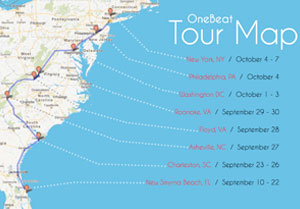
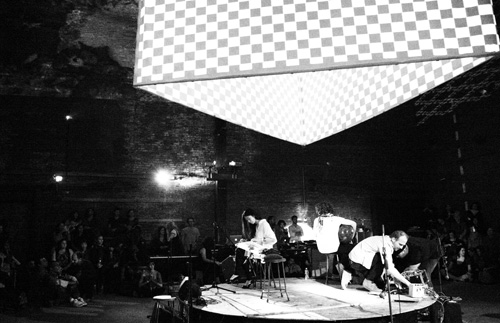
The OneBeat tour, for which the fellows traveled along the East Coast and for a short distance along the Appalachian mountain range, took place at large and small theaters, churches, galleries, live bars and city plazas. These performances, which brought together songs from different countries, were all sold out in most cases. As I mentioned before, a huge number of songs were created and arranged during the first two weeks of the project and some songs were even created during the tour. These songs were designed to fit the theme of each performance before being played on the stage. The themes included acoustic jazz, quiet songs with a religious atmosphere, pop music like hip-hop and electronic music, avant-garde music and folk music. These different genres were sometimes mixed together appropriately to offer performances rich in sounds and sights.
The OneBeat tour included not only performances on the stage but also a number of social engagement programs. In fact, the latter was commensurate with the purpose of founding Found Sound Nation which planned OneBeat; that purpose is "the social engagement of music." Such social engagement programs also constituted the focus of the entire project. For example, the fellows participated in workshops and meetings held in each region’’s YMCA, and in elementary / middle / high schools and universities. They also appeared on local radio programs. Moreover, they played music in a large plaza or a park and created and recorded music with passersby in the Street Studio. They also presented their musical performances at the telecommunications museum. Such social engagement programs were the results of the fellows’’ meetings that were held during their residency period. Indeed, the fellows had gone through in-depth discussions on the role that the medium of music plays in the entire society through public art, music for children, adolescents and adults, and music related to the international community and politics. What they discussed was able to become a reality during the OneBeat tour.
As for the discussions that went on during the residency period, what impressed me was the meeting on international politics and society. The fellows seriously discussed with each other about the role of music in places with or without freedom of expression (e.g. US and Cambodia respectively) and in societies where people die from hunger and hardships while the government is rich (e.g. Congo). I just attended the meeting to talk about the role of music in a capitalist society but beyond this, I was able to learn about a whole new role of music by exchanging ideas about the role that music plays for humanity as a whole. To summarize, the OneBeat tour was for all members of a given local community because it not only presented performances to the audience but it also allowed everyone to reflect on the broad meaning of music.
|
|
| |
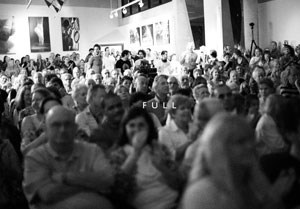
| OneBeat Tour Map | The first tour performance at ACA Gallery. The seats were all sold out so the performance even had to be moved to a larger place. |
OneBeat SM, Origin of a New Musical Culture
OneBeatSM is a small club without borders where its fellows use music as a tool to communicate with each other, to create a new world and to enjoy themselves. What was the most meaningful during this month-long musical journey full of new things was the fact that it provided the fellows with a hands-on experience of discovering the diversity and potential of music. Many professional music schools narrow the focus of the artists studying there and teach a particular way to create and play. This has the consequence of stifling creativity. Since I was educated that way, I have been very thirsty to experience diversity and new possibilities. In that sense, OneBeat was comparable to a wide open window breathing a new vision into my music.
Today, culture seems to be a medium that enjoys greatest diversity. If culture successfully maintains its diversity, it will be more influential than anything else. No matter what today’’s biggest issues are, if music can lend even a little support to all members of society so that they can live a beautiful life, I will be happy as a musician living in this era.
|
|
| YPK Project_Project carried out by Korea, Lebanon and Poland |
Related Links
| OneBeat GO
| Bang on a Can Go
| Found Sound Nation Go
| ACA Go
| Article from The New York Times on OneBeat Go
** All rights of imagery data are reserved by Found Sound Nation, those of photos, by Hannah Devereux and those of videos, by Temujin Doran.
 PREV
PREV
.JPG)
.jpg)
.jpg)
.jpg)
.jpg)












;)


