





Important Considerations in an Era of Cultural and Artistic Exchanges between Nations
[Trend] Goals for the Art Circle in 2015: The “International Exchange” Edition
The volume of export and international exchange involving Korean art is rising exponentially, thanks to the growing interest in the Korean Wave and a relatively firm public support. The quality of the Korean art has taken a leap forward as well, causing the traditionally European or Western-biased interest to begin shifting toward new areas: South America and the Middle East, as well as China and other Asian countries that were rather behind in cultural exchange.This high degree of fascination in a new area, however, cannot be attributed to changes in the global economic paradigm alone; it would be profoundly related to the nature of art that tends to pursue subjects that are “unfamiliar” and “new.”
The current period is often characterized as a time of ushering invigorous international exchanges of culture and art. As a member of an organization that seeks to vitalize these sorts of exchanges, I would like to comment on a number of things that should not be overlooked during this particular phase in our cultural history.
Encouraging Mobility of Artists and Those Involved in Art
It is impossible to overemphasize the importance of supporting for the mobility of artists and industry professionals—quite literally, in this case. Travel expenses such as airfare, the basic arrangement for an international exchange to take place,are the most commonform of grantdue to the tangible benefits these funds are able to have when compared totheir cost. The Arts Council Korea (ARKO)’s Support for Civil International Arts Exchange and KAMS’ Center Stage Korea are two examples where grants revolve around an applicant’s transportation costs.
The range of support for mobility has broadened, fortunately, and many organizations have recently partnered and begun contributing to a joint fund, organized through multilateral cooperation on national and organizational levels. On one hand, such cooperation reflects the abysmal economic climate, as a more unified actionlessens the amount of financial burden on applicants; in addition, it demonstrates a more solid commitment from funding bodies as far as offering support to revitalizethe exchanges that occur between artists and planners. In some countries, however, Korea included, it has been impossible to make this type of collaborative funding a reality due to restrictions on where award money could be used. A few years ago a Korea-Japan-Singapore “Asia Mobility Fund” was under way for the promotion of culture and arts, but the plan failed to materialize as Korea’s public funding was reserved for domestic participants.
|
| |
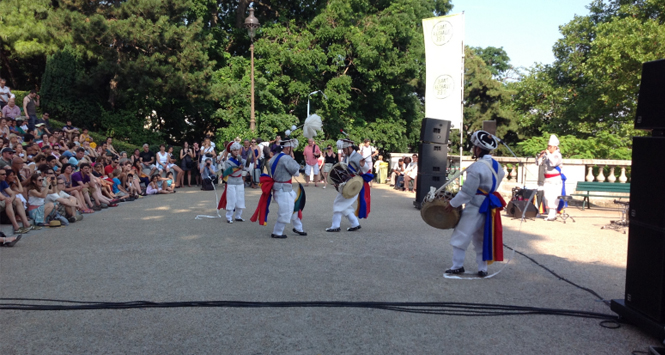
| ▲ Performance of NoreumMachi, one of the applicants, at the 2013 Paris Summer Festival as part of KAMS’ Center Stage Korea Project | |
To overcome these hurdles, ideas are being developed to maintain each country’s usage restrictions while shaping the overall framework of the joint fund. This new system operates in a similar way that a large basket (which represents the joint fund) might hold marbles (funds from each country) of various colors (different rules and conditions). A marble of an appropriate color can be chosen to be used as a fund. Titled the “Mobility Funding Platform,” this method can help prevent reoccurrences of past failures. The joint fund is expected to materialize this year, and the Southern Europe/Asia/Arab geographical zone/Australia (SEAAA) Mobility Platform is one of funding sources that is scheduled to take effect as part of the launch. Europe’s Roberto Cimetta Fund will be responsible for executing the plan, drawing from its expertisein the activities of European and Middle Eastern artists, while the Asia-Europe Foundation will be sponsoring the project. Public and private organizations in Southern Europe, the Middle East, Asia, and Australia—including Korea’s KAMS—will assist in raising funds.These combined efforts are hoped to facilitate the mobility of artists and industry professionals as they travel to events located across these regions.
Establishing a joint fund among Korea-China-Japan or between ASEAN-Korea is an action item for regional exchange currently being pushed forward by the Korean government. The aforementioned funding platform would be a useful reference point as Korea attempts to enact its own funding network. This is particularly crucial due to the country’s growing demand for diverse and multi-leveled support systems that guarantee unrestrained mobility for those involved in the arts circle.
Support That Ensures a Sustainable Exchange
A sustainable exchangeis essential to strengthen international exchangesand to lay the foundation for international cooperation. What must come prior to this stage, however, is an in-depth understanding of the partner, as well as a strong sense of need for this second party. Unfortunately, these two aspects are not enough; it is imperative that the system in question be able to sustain the partnership, whether it is through a sound network or a support for such a network. There are a variety of support systems—namely, (1) short-term or annual, (2) mid- to long- term or over the span of many years, or (3) divided into phases—that are known to contribute to sustainable exchanges. Collaboration in particular requires a considerable amount of labor, andits two most prominent forms are astep-by-step support and continuous assistance. Although still insufficient, continuous exchange was made possibleto some extentthrough long-term support that helped nurture the project from the research stage to execution. Examples of this process include ARKO’s Support for Mid-term International Exchange Plansprogram and KAMS’ Global Capacity Building Project for Performing Arts (also known as KAMS Connection), as well as KAMS’Project VIA for visual arts. Regardless of the source, it is clear that the level of support offered must expand and must challenge the barriers of the current system.In practice, this type of unconventional support would ideally encourage collaboration among organizations that distribute aid in stages, or would remain focused on the process rather than the result, because while the outcome is important, past experience suggests that superior results cannot come without significant effort. This is especially true when it comes to international exchange projects.
|
| |
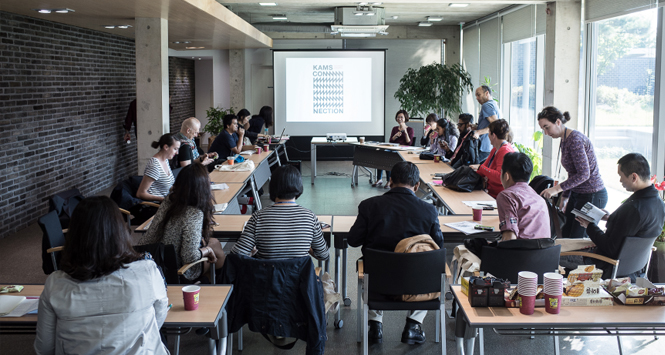
| ▲ At the Korean research site of “Korea-Australia Connection” and “Korea-Malaysia Connection,” an initiative pushed forward in 2014 by KAMS under the idea of Global Capacity Building Project for Performing Arts | |
|
|
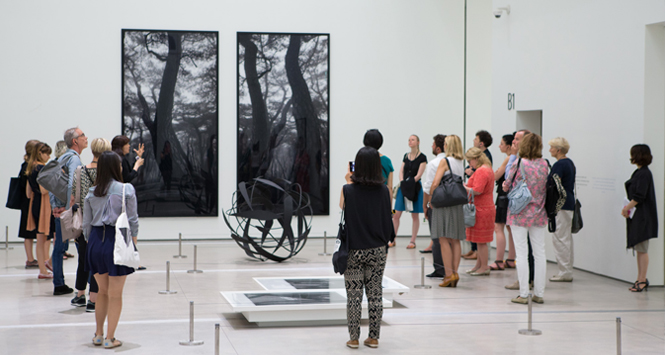
| ▲ Presented to the Netherlands’ Mondriaan Foundation by KAMS as part of the 2013 Project VIA, the Orientation Trip was executed in 2014. In line with Korea’s Biennale Season, participants toured the facilities of various visual art-organizations, including both private and national institutes, alternative spaces,and residential programs. |
Encouraging Regional Exchanges
In the interest of diversifying the types of experiences participants can have through international exchange programs, it is crucial that more invigorating exchanges are arranged in communities outside the metropolitan areas. This is a practice that has frequently been carried out between the local governments of sister cities located in the same region, though the interchanges were mostly limited to the economic realm; moreover,cultural and artistic exchanges were only done for the sake of an event. In spite of this history, a positive regional partnership can promote exchange and yield better results because it allows participants to gain experience outside their native region. For instance, Busan utilizes its geographical and diplomatic proximity1 to Japan to coordinate exchanges with Japanese cities Tsushima, Shimonoseki, and Shizuoka. The Watagata Art Festival is another exchange program that sets Busan apart.
Another promoter of regional exchange is the Busan Cultural Foundation, which participates in Performing Arts Market Seoul (PAMS) annually to introduce its artists while actively partnering with foreign organizations to finance research. As a result, the foundation became part of Künstlerhaus Bethanian, a creative space in Berlin, Germany. By employing a strategic approach to their networking, the international exchanges emerging from these regions have managed tooutshine those of the capital areas. Their success offers concrete motivation for the initiation of a more aggressive promotion for regional exchanges.
1) In Joseon-era Korea (1392–1910), Busan’s southeastern coastal location played an important role in the country’s diplomatic ties with Japan, serving as a gateway for the central government’stongsinsaprogram (“Diplomatic Program to Japan”).
‘Regional Experts’: The Key to Boosting International Exchange
As is the case with many other areas, one of the challenges of stimulating international exchange is the deficiency of experts in the field. There are scores of experts in Eastern Europe and North America who have developed networks and knowledge resources in their regions based on lavish experiences, but this is not true for South America, East Asia, and Middle East, where exchange networks are less established. A deficiency of experts in the fields of culture and arts has contributed to a track record of fairly shallow exchanges, as has the dearth professionals with expertise in the language of the partnering country. Put simply, experts cannot be fostered overnight and a long-term plan is needed.
Just as a great travel guidebook cannot replace the experience of travel, the personal development cultivated through cultural exchange cannot be realized through sitting in a classroom or attending an online lecture. This is the exact rationale behind the call to increase on-site programs—for example, foreign internships or residency courses—adding to the significance of KAMS’ NEXT Expert Training Launched in 2013, the program involves sending experienced industry professionals to Korean Cultural Centersoverseas for between one or two years, allowing them to work in an environment that will help them improve their planning skills and build networks will broaden their expertise. Such experience will help the planner to not only gain an understanding of the industry practices of the local organization but to also acquire the skills to conduct and support practical business exchanges between Korea and their host country. In 2015, the project will expand to countries with top local cultural exchange organizations, with some organizations having already expressed interest in partnering with KAMS and mutually exchanging human resources.
ⓒKAMS
|
◈ International Exchanges that Deserve Attention in 2015–2016 Of all the news, the September launches of both the Asian Culture Complex in Gwangju, Korea, and the 2015–2016 Korea-France Year of Mutual Exchange in Paris, France, would certainly be the hot issues in the field of cultural and international exchange.Operating under the theme of “Cultural Window to the World,” the Asian Culture Complex will showcase diverse international programs that cover a wide range of contemporary Asian work including a remake of Philip Glass’opera “Einstein on the Beach,”along with many others. In addition to hosting the European Festival Association’s “Atelierfor Young Festival Managers,”the complex will also be used to holdsignificant international conferences and forums, improving its status as a hub forartists interested in the Asian region. Some industry professionals mayrememberKAMS’ significant achievementsin year 2014: In addition to co-presenting with Sookmyung Women’s University at the International Conference on Cultural Policy Research (ICCPR), attendees at theHildesheim,Germany, event successfully lobbied to have Seoul host the 2016 conference. The city successfully fended off competition from powerful rivals such as Liverpool, U.K.,and marks the first time the event will be held in Asia.Scheduled for July 2016 at Sookmyung Women’s University, the conference is expected todraw many scholars and policy makers in the discipline of cultural policy, and is known to lead to wide spread advancements in the field. A mid- to long-term plan for international culture exchange will be announced by the central government in June or July of this year. A study to support the plan’s design was first proposed by the Korea Culture and Tourism Institute in the second half of 2014 and is expected to be completed by the middle of 2015. This is the first proposal of its kind since 2004,at which pointa similar study was planned to examine the support offered for international cultural exchange. Though the decision to reinitiate the project may appear futile, the research’s relevance to the field means it warrants further consideration. Compared to the frequent export of Korean musicals and nonverbal performances to the Chinese and Japanese markets, the debut of small-scale productions in other regions may appear insignificant. But 2015 will be a new era for Korean theater’s expansion overseas, starting with the company’s participation in the Edinburgh Fringe Festival during this coming August. This will be followed by a performance at a major theater in London in 2016, an especially exciting debut given England’s significance to the history of Western theater. The production agency is yet to make an official announcement, thus the title of the piece and the location of the performance are still unavailable. Considering that Korean plays are particularly challenging to export due to the language barrier and the general financial constraints facing theater companies, the debut of a Korean playin a foreign country will be an excellent start; the response from foreign audiences will be particularly interesting. |
 PREV
PREV
.JPG)
.jpg)
.jpg)
.jpg)
.jpg)











.jpg','The volume of export and international exchange in..');)


