





New Artistic Activities Encompassing Form, Attitudes and Environment
[Trends] Festival/Tokyo Korean Edition, Korean Dawon Art(ダウォン芸術)
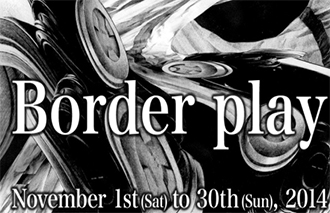
Festival/Tokyo 2014 was held from Nov. 1st to 30th at locations scattered throughout the Japanese capital: the Tokyo Metropolitan Theatre, the city’s theaters and parks, and the Shinagawa district. The show included 15 installations, including Peter Brook’s festival opener <The Valley of Astonishment>, a video feature on Christoph Schlingensief, who passed away in 2010, four symposiums with the theme ’diversity in art’, and a ’Three-Night Talk Series’ with the theme ’Thinking about Performing Arts Management’. In addition to Brook’s piece, which featured Asian themes, an emphasis on continental Asia was particularly noticeable across the various foreign works featured in the festival, with contributions from Palestine, China, Myanmar and three from Korea.
|
|
|
| Official poster for Festival/Tokyo 2014 |
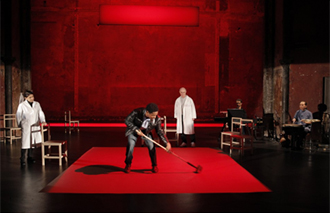
Peter Brook’s <The Valley of Astonishment> the opening piece |
Collaboration and Asia
Like the theme of the festival, ‘border play’, I wonder if the keywords that describe this festival, from the pieces to the symposiums, are not ‘collaboration’ and ‘Asia’. These themes were reflected in the five pieces Festival/Tokyo introduced as part of the festival program, each of which created by a diverse selection of artists. Collaboration between creators working in various fields is always a part of performance arts production, but unlike the established method of creators participating as one part in a production with a unified theme, this time the goal was to promote collaboration between independent creators. For example, in the performance of
Yet another noteworthy effort at Festival/Tokyo this year is the debut of the ‘Asia Series’. The Festival/Tokyo Asia Series begins from a perspective that differs slightly from the notion of ‘Asia’ that has recently been making waves in the performing arts world. More specifically, rather than present the impression of Asia that comes from a Eurocentric worldview, the Asia Series proposes an Asian identity built from more concrete and direct interaction with the continent’s culture and people. For example, if Toshiki Okada is introduced to us as a discovery from the European avant-garde scene, and if we’re being introduced to ‘Asia’ as observed by this Western-based patron, then Festival/Tokyo indicates an attempt to construct a more direct network. Following this year’s Korean edition, the Asia Series will cover Myanmar in 2015 and Malaysia in 2016, decisions that represent the considerable thought given to an a perspective of Asia that, up until recently, adhered to a more Eurocentric view . Furthermore, the Asia Series attempts legitimate collaboration instead of simply introducing each culture’s performances as distinct sections of the festival program. The close relationship between Festival/Tokyo and Festival Bo:m can also be attributed to the collaborative process. Festival Bo:m art director Lee Seung-hyo, who was involved with this year’s Asia Series as a programmer, pointed out that Festival/Tokyo’s Asia Series was "Japan in the process of being seen as a scene in Asia," and that the Korean edition was a search for a common foundation between Japan and Korea.
|
|
|
| <The Rites of Spring> ⓒYohta Kataoka |
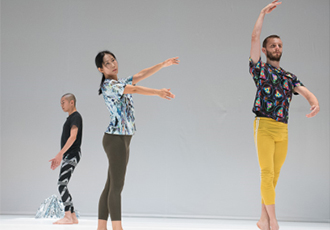
Lim Jeeae’s <10 Years in 1 Minute>, part of the Asia Series ⓒKazuyuki Matsumoto |
The Impossibility of Translating ‘Dawon Art(ダウォン芸術)’
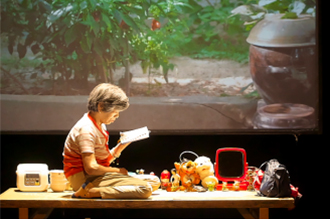
The Korean edition, which made up the first part of the Asia Series, was curated under the theme of ‘Dawon art’, or pluralism in art, and included three pieces—<From the Sea> by Seo Hyun-suk, <The Conversations> by Creative VaQi, and <10 Years in 1 Minute> by Lim Jeeae—as well as a symposium titled "The State and Future Prospects of Korean Dawon Art." The uniquely Korean flavor of this year’s theme is reflected in the fact that the expression ‘Dawon art’ was not translated into Chinese or English in the festival’s program materials; instead, the word was phonetically written out in Japanese(ダウォン芸術). The programmer of the Korean edition, Lee Seung-hyo, said, "As much as the performance pieces themselves, the decision to not translate ‘Dawon art’ and instead introduce it as a unique concept was just as significant a part of this year’s program." The plan for the symposium was to present, with greater focus, the concept of Korean Dawon Art.
|
|
|
| Seo Hyun-suk’s <From the Sea>, part of the Asia Series |
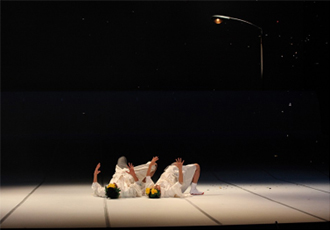
‘Creative VaQi’s <The Conversations>, part of the Asia Series ⓒTsukasa Aoki |
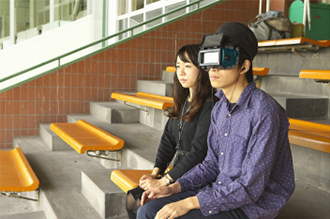
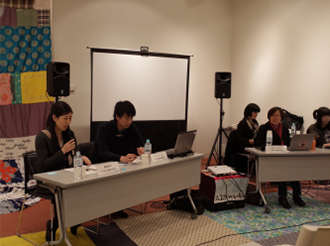
The symposium took place on Nov. 16 at 5 p.m., the closing day of the three performance pieces, in the atelier of the Tokyo Metropolitan Art Space where the Creative VaQi and Lim Jeeae pieces had been shown. Korea edition programmer and Festival Bo:m art director Lee, critic Bang Hye-jin, and I were responsible for presenting. First, Lee discussed the development of Dawon art and introduced Festival Bo:m as a major showcase for Dawon art. His explanation focused on the fact that Korean Dawon art began with policy support for new artistic activities, and with the establishment of a Dawon art scene, works that had no place were given a legitimate cultural space. For example, Song Hojun’s <OSSI Electronic Parts Rap> avoided featuring its namesake satellite—that is, the satellite that Song Hojun launched privately—and instead profiled the societal reactions to his launch. On one hand, Song’s piece exemplified Dawon art in that it focused on process rather than result; on the other hand it also illuminated the aspect of Dawon art that provokes new questions about what constitutes art.
I approached Dawon art from the perspective of art policy, focusing on the activities of Arts Council Korea’s Dawon Arts Subcommittee. This involved describing the historical context of how both organizations came to be, from the increased activity in non-mainstream genres taking place around festivals in the 2000s to the new sensibilities and artistic activities of a new generation. Spanning a wide expanse of cultural ground, the activities in question include events such as the Seoul Fringe Festival and its more independent counterparts, the transformation of the Korea Culture and Arts Promotion Act to the privately run Arts Country Korea, and a social atmosphere that called for a change to the inflexibility of art policy at the time. I also focused my presentation on the debate surrounding arts support policies and how they could adapt to the new types of artistic activity being attempted by the Dawon Arts Subcommittee.
As an art critic, Bang discussed the artistic activities currently in the spotlight in the Dawon art scene, exploring the significance and possibilities of Dawon art from the perspective of this era’s art. His analysis also addressed how the post-genre/multi-genre climate and artistic activity emphasizes the process rather than the result, relating this phenomenon to contemporary art and the characteristics of pieces from this specific generation.
A diverse audience participated in the symposium. Audience members who had seen the Korean edition performances, critics, performing arts industry professionals, journalists, arts management professionals, and workers from various support organizations demonstrated their interest in Korean Dawon art during the question and answer session that followed the presentations. One participant asked how such varied pieces with contrasting visions could all fall under the common category of "Dawon" art, while a festival professional asked what sort of crowds a Dawon art–focused festival such as Festival Bo:m might draw. There were also detailed questions on Dawon art support policies, such as queries on whether public interest could result in the funding of arts policies that focus on a younger generation alienated from established mainstream art, non-mainstream genres, and new artistic activities, or how pieces were evaluated in a support program that focused on processes rather than results.
|
|
|
| 2014 Festival Tokyo Symposium |
Theater critic Kim So-yeon, who participated in the symposium as a panelist |
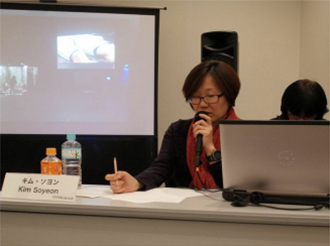
As the presentations of the three panelists continued, it became subtly apparent that there wasn’t complete accord between the three on the understanding and definition of Dawon art. These differences were emphasized in the presentations themselves, and the impossibility of reaching an agreement, or even a partial agreement, was touted as one of the features of Dawon art. The differences in understanding and perspective among the three presenters were also apparent during the question and answer session. For example, when Lee was asked about the Dawon-like characteristics of the three pieces introduced as part of the Korean Edition, the director answered with an emphasis on how each of the pieces demonstrated a certain attitude toward art, rather than discussing any formal commonalities shared by all three pieces. Bang, by contrast, spoke of artist Seo Hyun-suk, with his roots in visual arts, and Creative VaQi, with its foundation in theater, and their parallel qualities with in the context of the mainstream art scene.
Given that Korean Dawon art has been introduced to the Japanese art world intermittently since 2010, this year’s Korean edition at Festival/Tokyo was a movement that, despite its small scale, was relatively organized in its introduction of discourses and works compared to the past. In particular, Lee’s efforts as programmer to introduce Dawon art not as a specific artistic form or tendency but rather from a multifaceted perspective that encompassed the pieces, activities, attitudes, environment and policy were successful to a certain extent. The audience interest in Dawon art as a whole that was demonstrated at both performances and question and answer sessions is different from the artist-focused response shown toward individual artists or performances, translating as an increased interest in each piece’s specific social context and overall artistic environment. Beyond the concept of Dawon art, there was also a great deal of interest in the three pieces themselves, and in regard to the individual works, none were so abstract that communication was outright impossible, even from the perspective of established genre practices. The criticism, too, showed that Dawon pieces could fit in with the approach of established genres such as theater and dance. Seo’s
Regarding the decision to forego translation of ‘Dawon art(ダウォン芸術)’, the cooperation of the Japanese audience and performing arts industry professionals can likely be explained by the fact that Dawon art was probably accepted as a concept tied to Korean society and the context of Korean art. At Festival/Tokyo I was also able to confirm that the emphasis put on that context was also one of the reasons why the Japanese art world found itself drawn to Korean Dawon art. When considering that, in the Korean art world, debate on Dawon art remains at a standstill, the Japanese response is both contrasting and intriguing. As to whether this outside debate can reignite the conversation on Dawon art within the Korean art world, as I witnessed the Dawon art in the Korean Edition of Festival/Tokyo,only time will tell.
ⓒFestival Tokyo Website
 PREV
PREV
.JPG)
.jpg)
.jpg)
.jpg)
.jpg)












.jpg','Festival/Tokyo 2014 was held from Nov. 1st to 30th..');)


