





Expectations for "culture" and "welfare for artists"
[Trend] Survey Results of ‘Top Five Arts Management Stories from 2013’
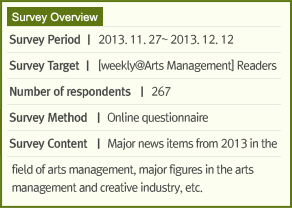 |
For two weeks from November 27 to December 12, the "Top Five Arts Business Management Stories from 2013" were nominated. What kinds of issues within the culture and arts industry did the industry insiders themselves deem worthy of notice? This year a total of 267 participated in the survey, and of the respondents 178 were female, comprising 66.7%, and 89 were male, comprising 33.3%. |
In terms of age distribution, 107 respondents were in their 30s and comprised 40.1%, 105 respondents were in their 20s and comprised 39.3%, and the proportion of respondents in their 20s and 30s together totaled up to 80%. Respondents in their 40s and 50s comprised 14.6% and 6% of the total, respectively.
Examining the type of profession of each respondent, 117 (43.8%) of the participants worked in the performing arts, 30 (11.2%) of the participants worked in the visual arts, and 81 (30.3%) of the respondents said that they worked in both fields. 39 (14.6%) of the respondents identified themselves as being in another category.
In terms of professional domain, a majority, 88 (33%), of the respondents were in funding/administration, followed by 37 (13.9%) in production/distribution, and 32 (13.9%) were students.
|
|
| ▲ |
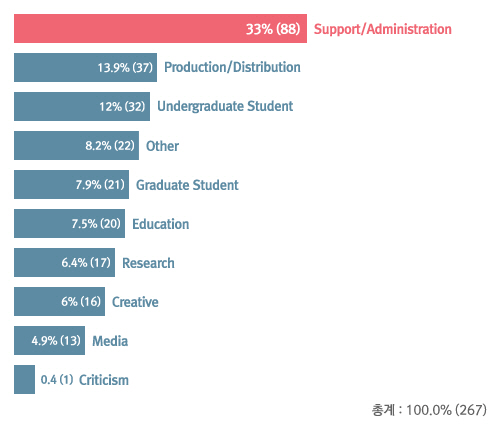
In terms of professional domain, a majority, 88 (33%), of the respondents were in funding/administration, followed by 37 (13.9%) in production/distribution, and 32 (13.9%) were students.
An Overall Increase in Culture and a Demand for the Diversification of Hallyu
The most significant questions posed by the survey, a total of 12 multiple-choice questions encompassing major news events of this year in the arts business industry, resulted in the following:
|
|
| ▲ |
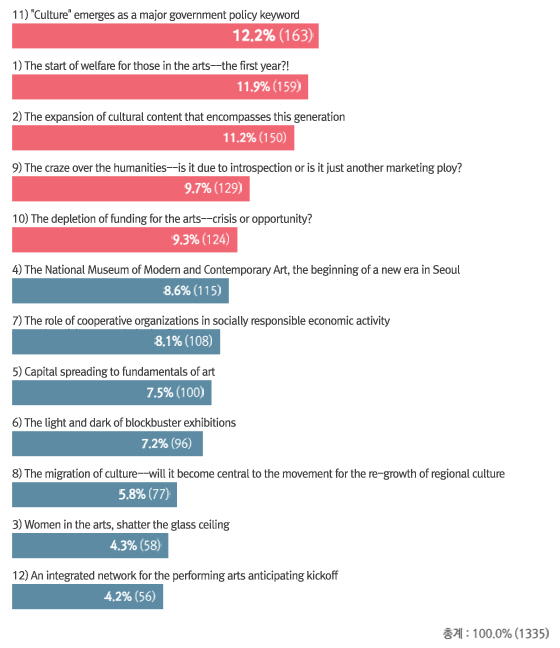
Number 11, "Culture" emerges as a major government policy keyword, received the most responses, with 163 participants comprising 12.2% of the total. Following, No. 1, "The start of welfare for those in the arts--the first year?!" received 159 (11.9%) votes, and then No. 2, "The expansion of cultural content that encompasses this generation," with 150 (11.2%) respondents, without much variation in votes among the top three issues. Following the top three the 4th and 5th most popular issues were No. 9, "The craze over the humanities--is it due to introspection or is it just another marketing ploy?" (9.7%) whether the depletion of funding for the arts was a crisis or opportunity (9.3%).
In the free response section of the questionnaire on the major news events of the industry in 2013, "the craze over convergence" and "Hallyu in the arts" each received attention from five or more participants. This year there is of course an interest in the convergence of the arts and science in the visual arts, but it was particularly emphasized in the performing arts industry. Festivals big and small even opened with "convergence” as keywords, but there was also criticism about the fact that many of the pieces presented simply "mixed" work without a basic understanding of the two different fields. The national expectations for the Hallyu that Korea’s cultural content was driving had not subsided, either. This year in particular was the year that there was special emphasis on a full-fledged popularization of Psy’s "Gentleman" (the successor to "Gangnam Style"), and besides that K-Pop, with multiple idols stars at the head, drove the continuous expansion of K-Food and other various aspects of Korean arts and culture under the banner of K-Culture into foreign markets. Of course, it has not passed by unnoticed that there remains a heavy emphasis on K-Pop within this flow, and that the Hallyu (Korean Wave) will not last unless it is backed up by a diversification in the cultural content that is exported. Further, there were opinions to the effect of "I want to know more about the conditions of the export and import of culture, and without remaining simply within the realm of content production, explore how these can be applied in various ways" and a desire that these topics be introduced through the [Weekly@Arts Management] newsletter.
In terms of personalities, the figures that garnered the most votes this year were the now-deceased Kim Ju-ho in the field of arts business management and artist Suh Do Ho in the creative field. Kim Ju-ho was among those selected in the first open call for personnel at the Seoul Arts Center and held posts in succession at the LG Art Center, as a consultant at METAA Consulting, director at the Korean Arts and Culture Education Service, and president at the Seoul Philharmonic. He was the president of the Lotte Concert Hall when he passed away on May 26 of a heart attack and his passing has been mourned by many in the arts and culture industry.
Artist Suh Do Ho, a contemporary artist in the spirit of Nam June Paik and Lee Ufan
Public awareness of Suh Do Ho has increased to the point where his Home within Home exhibition, which opened at Samsung’s Leeum in 2012 attracted the highest number of visitors since the opening of the museum. Suh Do Ho will also hold an individual exhibition at the Seoul branch of the National Museum of Modern and Contemporary Art, which opened last November. After being featured in the November issue of the Wall Street Journal Magazine as "this Year’s Innovator," Suh recently took the top prize for TV, film, cinema and animation at Germany’s Red Dot Design Awards and is currently one of the most well-known artists in the country.
 PREV
PREV
.JPG)
.jpg)
.jpg)
.jpg)
.jpg)












;)


