





Focus on Networks!
[Trend] Looking for a Sustainable Korean Wave in the Performing Arts: The Role of the Public Sector
We use the term “Korean Wave,” or Hallyu, to describe the trend of Korean popular culture finding an international audience. It’s a very non-cultural term, though—indeed, it’s quite commercial, political, unilateral. Personally, I have never once used it in all my time spent as director of the Korean Cultural Center in Paris. This is partly because it is so contrary to the values and goals of international cultural exchange, but also because even aficionados of Korean culture around the world dislike the term. In our own internal forums for discussion, we understand the term Hallyu, in the context of the performing arts, to mean a push for greater interchange activity with Korean productions. I would like to begin this piece by talking about the Korean Cultural Center in France.
Korean Cultural Center(KCC) : A Focus on Networking and Marketing
As of December 2012, there were a total of 24 Korean Cultural Centers around the world. Except for the ones in the US, Japan, and France, which were founded more than 30 years ago, all of them are relatively new, having arisen in the last ten years. There are also around 90 Sejong Academies teaching the Korean language to people around the world. Conditions are almost uniformly poor—there is usually one person deployed as chief, with locals staffing the different positions—but I think they offer enough of a foothold for sharing and spreading Korean culture and art internationally. In the past, these centers have held events to introduce Korean culture and art, intermittently and directly,to local audiences on behalf of the Korean government. They have also worked to promote Korea’s national image by publicizing its culture. But now that Korean popular culture has extended its reach outside Asia and is drawing attention from around the world, the KCC’s mission needs to be recalibrated. As we all know, culture is different from information, technology, or international politics. Sharing it cannot just be about broadening understanding through publicity. Culture is something to share and love together, as a personal experience. What Korea’s culture and art need is not to be used for one-off, diplomatic events around the world. They require localization within the context of different cultural spheres, part of a permanent, bidirectional system of interchange on the ground in whatever country. The KCCs have been set up to fulfill just this role, so what we need now is to find a way of using them to promote exchange in culture and the performing arts. The Ministry of Culture, Sports and Tourism is now considering some possible roles for the centers to play as major actors in turning Korea into a “cultural power that connects with the world.” These include those of cultural intermediaries promoting international exchange, network-makers, cultural marketers, and providers of Korea-related information. I think this is a positive change. In the paragraphs that follow, I will focus on those roles, their meaning, and their effects.
Deciding on a New Mission
During my time as a KCC director (2007–2011), I worked to promote the center as a space for cultural information and activities. I changed the external mission from serving as a supervisor for Korean cultural efforts to functioning as an active mediator, helping Korean culture and artists find a normal (and rightful) place in the overseas community and extend their reach. The first stage in this was ① meeting with as many local cultural centers, spaces, and festival organizers as I could and sharing Korean culture and arts with them, working to persuade them to incorporate Korean things into their programs. It’s a time-consuming process, but not a very difficult one if you do the research on the local scene. The French and German cultural centers in Korea were very prolific with this kind of work, and it paid dividends. The most active of the 46 overseas cultural centers in Paris—those of Taiwan, Great Britain, Belgium, and Germany—focus on this sort of thing all year long. At the Japanese culture center (Japan Foundation), there is one official in charge of the program for Paris and two more for the rest of the country.
After that comes the next stage : ② connecting invitees with the Korean cultural specialists (or specialty groups) in charge of that kind of work. These include Korean festivals and related organizations, planners, and groups. This way, professionals from both countries can get in touch directly, meeting each other’s needs and carrying out the necessary preparations—with a professional network naturally taking shape in the process. Once the matchmaking process is finished, the next role for the cultural center is ③ coordinating between them, or collaborating as a state organization. While the project is going on, it cooperates actively on publicity, working to ④ create another human network with Korean professionals overseas, encouraging them to attend events and building ties with local institutions. It is these professionals—Korean and local—who will be developing the project on a permanent basis. Obviously, the centers should also provide help as needed when the situation calls for intervention duringthe professionals’ preparation process. Its staff might write recommendations for assistance with travel expenses between Korea and France; the center may contact the support organization itself to make a request. And when difficulties arise with paying artists or carrying out events, it coordinates and helps out. The organizers are tremendously grateful for this, since they can receive assistance that is much more active than what they encounter in their other programs, and they tend to do whatever they can to ensure a successful performance and follow-up programming (if only for the feather in their own caps). As a result, the cultural center ends up becoming a joint supervisor or planner rather than a lone organizer. But its role goes beyond this: it also ⑤ offers creative support for local (in our case, French) artists working with Korean artists or groups, contacting the French cultural center in Korea and various support organizations at home as part of an active effort to create an environment where artists on both sides can work on an international collaboration. During my term, it was most often dance, but we also supported coproductions in a range of other genres—theater, music (classical, Korean traditional, jazz), and opera—with results that found an audience not only in France and Korea but around the world.
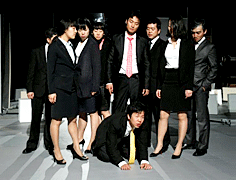 |
| 2012 touring performance of Rhinoceros, a Korean-French coproduction |
Boosting Synergy with Networking Connections
As this suggests, a lot of time and effort go into creating a single program.But once that work is done, most of the follow-up programs proceed straightforwardly and lead to requests from similar organizations and festivals, which then develop in their turn—and all of this because of the first example of successful Korean cultural or artistic programming within the French network. Productions enter naturally into the artists’ network, and the cultural center contributes as catalyst to expanding them spatially and temporally. Once a dramatic piece has been recognized in the performing arts network, it leads to invitations from various theaters, first for the work in question and then for other examples of Korean performing arts. In the French case, the group Wuturi’s plays Koreans and Wuturi were first invited in 2008 by Scène Nationale Evreux Louviers, a network of public theaters. They were repeatedly invited back after that that, programmed by other national theaters of dramatic centers in 2009 and 2012. In the process, theaters become more interested in other Korean performances, and a version of Hamlet by the group Yohangza ended up being invited in 2010 for a third-year Korean performance program at the Centre Dramatique National in Dijon. Similar examples include Lee Jaram’s Sacheon-ga (Paris, Lyons, and Avignon in 2011) and Eokcheok-ga (Lyons and Paris in 2012), as well asa coproduction of Rhinoceros by the Théâtre des Halles, HANPAC, and the KCC (Avignon and Seoul in 2010/2011, a tour of six French theaters in 2012).
Other cases can be seen in the traditional arts. Several different programs have been included in the yearly Imagination Festival organized by La Maison des Cultures du Monde (the Yeongsanjae ceremony in 2008, performances by Ha Yong-bu and Ensemble Baramgot in 2009, another show by Ensemble Baramgot in 2010, the Bongsan talchum in 2012), resulting in a continued partnership taking shape. In the fall, regular recitals have been scheduled at La Maison, with performances and tours invited to many other theaters and museums afterwards. Back in Korea, the Gugak FM radio network, the National Gugak Center, and producer Kim Seon-guk have been working to develop collaborative ties, with a ten-year plan set up in 2011 to release records of traditional gugak music on the state-run network Radio France’s Ocora label. Releases like a 2011 recording of a Jongmyo Jeryeak performance and a 2012 recording of a gayageumsanjo in the Choi Ok-sam style, as well as continued radio broadcasts, have helped share Korean music and build a base of French listeners. In the area of dance, a number of residence/performance invitations have been extended, primarily to soloists (Lee Sun-A, Jeong Geumhyung). While discussions were under way on dance programming, long efforts at persuasion paid off when the Festival Paris quartier d’été invited the Eun-me Ahn Company to perform in 2013. The networking successes in the performing arts have also led to invitations to various arts festivals, many of which have programmed special Korean sections highlighting different performances. The list has grown to include the Puppet Festival in Charleville-Mézières (2009), the Strasbourg International Contemporary Music Festival (2010), the Festival Made in Asia in Toulouse (2011), the Digital Arts Festival in Enghien-les-Bains (2010), and the Théâtres des Halles, Scène d’Avignon (2010/2011), which has led in turn to programming at various different festivals throughout the year.
|
|
|
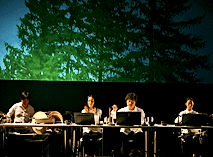
| Performance at Gallery | Be-Being playing at the Digital Arts Festival in Enghien-les-Bains |
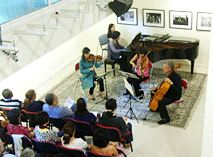
Another example that is well-known to Koreans—a hugely successful June 2011 K-pop concert in Paris—was not the result of any independent or one-off planning efforts. It came from a process that was similar to the above examples. In its simplest terms, it was the product of a human network gathering young French people with a love for Korean culture together. Around five or six people, students in a Korean language class at the Cultural Center, got together in June 2009 to discuss different cultural projects. They ended up forming an organization called Korean Connection and spending the next two years planning and supporting yearly Korean culture festivals, summer culture camps, summer Korean courses, and holiday events. They were planning a large-scale Korean culture festival in May 2011 as part of these efforts when they decided to stage a K-pop concert. The KCC, which receives public (government) support, provided an overall framework for the performance, and organization members pitched in with all the preparations: renting a theater, conducting various questionnaires, demonstrating at the Louvre, organizing huge airport welcome parties, and publicizing the concert. SM Entertainment, a Korean agency, developed a world tour project, and the event was staged with a mega-scale concert production called Live Nation. In short, everything was the result of committed contributions by private professionals, the government, and local enthusiasts. The local production company, one of the biggest in the field, was astonished by the success of the concert, and theconcert received a warm welcome from the French pop industry. It wasn’t just a victory for a single event aimed at bringing K-pop to Europe—it also made it easier for follow-up efforts to be organized. The positive response within the professional network led quite seamlessly to events like KBS Music Bank and a concert by Super Junior. This wasn’t the only opportunity offered to the arts, however. The fans’ grandparents, parents, siblings, and friends all came to learn about these attempts to show the “magic of Korea” in the fields they enjoyed. As people for whom performing arts were a daily pastime, they cheerfully flocked to the Korean performances. The new demand was a very encouraging sign to our local partners on the ground.
Building a Networking Support System
As this suggests, a lot of time and effort go into creating a single program.But once that work is done, most of the follow-up programs proceed straightforwardly and lead to requests from similar organizations and festivals, which then develop in their turn—and all of this because of the first example of successful Korean cultural or artistic programming within the French network. Productions enter naturally into the artists’ network, and the cultural center contributes as catalyst to expanding them spatially and temporally. Once a dramatic piece has been recognized in the performing arts network, it leads to invitations from various theaters, first for the work in question and then for other examples of Korean performing arts. In the French case, the group Wuturi’s plays Koreans and Wuturi were first invited in 2008 by Scène Nationale Evreux Louviers, a network of public theaters. They were repeatedly invited back after that that, programmed by other national theaters of dramatic centers in 2009 and 2012. In the process, theaters become more interested in other Korean performances, and a version of Hamlet by the group Yohangza ended up being invited in 2010 for a third-year Korean performance program at the Centre Dramatique National in Dijon. Similar examples include Lee Jaram’s Sacheon-ga (Paris, Lyons, and Avignon in 2011) and Eokcheok-ga (Lyons and Paris in 2012), as well asa coproduction of Rhinoceros by the Théâtre des Halles, HANPAC, and the KCC (Avignon and Seoul in 2010/2011, a tour of six French theaters in 2012).
Other cases can be seen in the traditional arts. Several different programs have been included in the yearly Imagination Festival organized by La Maison des Cultures du Monde (the Yeongsanjae ceremony in 2008, performances by Ha Yong-bu and Ensemble Baramgot in 2009, another show by Ensemble Baramgot in 2010, the Bongsan talchum in 2012), resulting in a continued partnership taking shape. In the fall, regular recitals have been scheduled at La Maison, with performances and tours invited to many other theaters and museums afterwards. Back in Korea, the Gugak FM radio network, the National Gugak Center, and producer Kim Seon-guk have been working to develop collaborative ties, with a ten-year plan set up in 2011 to release records of traditional gugak music on the state-run network Radio France’s Ocora label. Releases like a 2011 recording of a Jongmyo Jeryeak performance and a 2012 recording of a gayageumsanjo in the Choi Ok-sam style, as well as continued radio broadcasts, have helped share Korean music and build a base of French listeners. In the area of dance, a number of residence/performance invitations have been extended, primarily to soloists (Lee Sun-A, Jeong Geumhyung). While discussions were under way on dance programming, long efforts at persuasion paid off when the Festival Paris quartier d’été invited the Eun-me Ahn Company to perform in 2013. The networking successes in the performing arts have also led to invitations to various arts festivals, many of which have programmed special Korean sections highlighting different performances. The list has grown to include the Puppet Festival in Charleville-Mézières (2009), the Strasbourg International Contemporary Music Festival (2010), the Festival Made in Asia in Toulouse (2011), the Digital Arts Festival in Enghien-les-Bains (2010), and the Théâtres des Halles, Scène d’Avignon (2010/2011), which has led in turn to programming at various different festivals throughout the year.
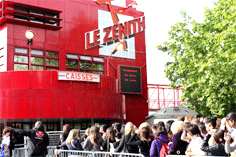 |
| People lining up for a K-pop performance |
Building a Networking Support System
Every kind of international cultural exchange needs networking and partnerships to produce results and progress. Professionals in the host country have to include the Korean performing arts in their own programs if we are to expand our audience base, promote consumption of Korean culture and art, and create a new culture through human exchanges. But it is when cultural centers (i.e., the government) and the Korean culture and arts communities lend their support, helping local professionals in those fields to “grow,” that the localization truly takes off. A good example of this can be seen in film, where influential French cineastes with expertise on Korean cinema helped it gain prestige locally
One last area that needs to be addressed is the kind of basic networking system that is crucial to promoting international cultural exchange. Because I had been directly involved in the culture and arts scene before becoming the director of a cultural center, I was able to set up a local network and make connections with various organizations in Korea—but this is often a tall order for a post that is typically occupied by an ordinary civil servant. That is why there needs to be a general support organization for international cultural exchange, working throughout the year to lend full support to the strategic presentation, local invitation, and propagation of various types of cultural content (primarily the province of private cultural and artistic practitioners). Organizations like France’s Institut Français, the British Council, and Germany’s Goethe Institute all work to develop and support international cultural exchange based on their country’s culture and arts promotion policies. In short, we require a primary channel and support base for various forms of cultural and artistic interchange. In the absence of such an entity, the KCC in France has been operating with support from various offices and groups associated with the Korean Ministry of Culture, Sports and Tourism, the Korea Arts Management Service, the Arts Council Korea, the Korea Foundation, local government cultural foundations, and festivals. For the performing arts to achieve the kind of presence on the international stage that the Korean Wave has, the role of Korea’s overseas cultural centers needs to change along the lines described above, and a suitably sized domestic organization needs to be established to oversee these efforts. Art is not like popular culture. It needs policy support in the medium to long term to create the kind of environment where it can win the hearts of the international public.
 PREV
PREV
.JPG)
.jpg)
.jpg)
.jpg)
.jpg)










;)


