





[Trend] Why we pay attention to the "Korean Wave" in Performing Arts - Cultural Identity
How we have met and failed to meet Hallyu: the hopes of a music director
Hallyu, the Korean wave, is the hottest topic of conversation not only in the area of music but among practitioners of virtually every genre of the performing arts. Music is at the very heart of Hallyu, from the international invasion of K-pop idols to the recent excitement over Psy.
When I see Southeast Asian fans who are more up-to-date on Korean singers than I am, jazz festival guests who are exceedingly grateful for being put up at a hotel in Gangnam, and overseas musicians who send us videos in which they handily perform songs by Korean artists, I feel as if Hallyu is almost here. But when I recall that the young Korean music students who sweep the prizes at global music competitions—along with a host of established musicians such as Myung-whun Chung, Sarah Chang, and Han-na Chang—are not regarded as part of Hallyu, and when I see that Korean gugak, or traditional music, has still not arrived at the center of Hallyu, even as many gugak musicians perform overseas with the support of the government—I feel as if Hallyu is still very far away.
Koreans are still waiting to see Hallyu become a reality in any genre of music other than commercial music centered on K-pop. Despite that, Hallyu is being touted as the route that all of us must take. Though I do not regard the Hallyu that is being bandied about in the press today as the genuine article, I have come up with a few pointers in the hope that, in the end, just once, the world will be touched by Hallyu in music and the performing arts.
The new Hallyu must start with the authentic Korean experience
When we Koreans talk about a musical Hallyu, some of the examples we often bring up are flamenco in Spain, fado in Portugal, and samba in Brazil. Perhaps this can help us understand why we feel such a gap between the Hallyu that we want and the Hallyu that we actually see today. What I mean is that the musical examples listed above are not merely genres of music but are rather musical forms that embody the history and identity of their respective peoples and nations. The people of Spain have laughed and cried with flamenco for hundreds of years. When people from other countries listen to flamenco, they are naturally reminded of everything related to Spain. They are able to experience Spain through the music even if they have never actually been to the country.
This is not just aquestion of the starting point, or where Hallyu ought to begin, but also a question of the direction in which we are moving, or what we hope to gain from Hallyu. Do we want Hallyu to enable the people of the world to experience the past and present of Korea and to imagine its future? If so, it will be necessary for us to begin with something that shows the most authentic aspects of the Korean identity.
Not long ago, Arirang was added to UNESCO’s Representative List of the Intangible Cultural Heritage of Humanity. So far, people from other countries have learned that Arirang is a Korean song, and its melody, at times playful and at times sorrowful, has brought many people both to laughter and to tears. If we need to define a starting point for musical Hallyu, something like Arirang would probably be a good choice. It is Korean music, of course, but it is also Korean history, and Korean emotion.
The new Hallyu must be first-rate
Every day, the global music and performing arts market is becoming more commercialized and specialized. If Hallyu is to become a valuable brand in such a market, Korea’s music and performing arts must be first-rate according to global standards. Just 10 years ago, no one could judge Korean music according to that standard. Korean music was no more than new, unusual music from a small country in Asia, and there was no one who was researching it or who could compare it with other kinds of music. But today, just as Koreans are able to determine whether a musical performance in a variety of overseas genres is of the highest quality (I am speaking not of commercial but of artistic assessment), so too has the world begun judging and evaluating Korean music.
Considering all of this, there are two kinds of musicians that have been a source of concern for me as of late. First are the musicians who have their hearts set on performing overseas but do not pay any heed to their own ability, even as they pretend that their music is the very essence of Korean music. Second are the musicians who are so confident in their own “amazing” talent that they bring along amateur musicians to play with them on tour. There have been some particularly embarrassing examples of this with groups that include Western-style instruments in their performance. Frequently, the overall assessment and quality of a group is diminished because the members have not gained a deep understanding of Western music or because the group includes subpar musicians. This sort of thing can sometimes even be seen at important events intended to show off the level of Korean music and performing arts to people from around the world. This is one of the greatest factors impeding the expansion of Hallyu.
|
|
|
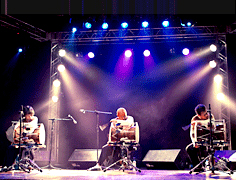
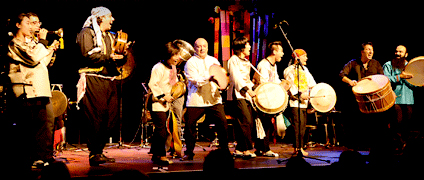
| A performance by Noreum Machi | |
The new Hallyu will only be achievable through collaboration and exchange
It is no longer possible for Hallyu to be brought about through music and the performing arts by themselves. Instead, it must be achieved through the coordinated effort of all of the available systems and people that are involved in these fields. On a direct level, this could include the division of roles among a variety of related organizations, the development of support systems, and organized promotion and marketing. On an indirect level, this might involve a system for educating performers, stimulation of the domestic industry in Korea, and research and archive development in connection with various art and performing arts sectors. Furthermore, since this kind of Hallyu is not sustainable without a certain degree of marketability, there is also a need for a culture-based business model. At the present, it is no exaggeration to say that this entire system in any given country represents the cultural and artistic level of that country.
Cultural history tells us that, when the Beatles learned from and took part in musical exchange with the Indian Ravi Shankar, Asian culture was able to establish itself as a culture in the West. In the same way, creating a platform for ongoing exchange with performers based in various cultures can be more effective than unilateral efforts to export Korean music and performing arts. In particular, compared to other genres, it is easier for music to assume an identity, and modification and cooperation can also be achievedsimply in music. Since music facilitates exchange with a variety of genres, including dance, theatre, film, and musicals, we can look forward to seeing the new Hallyu emerge not only in the genre of music but also in these other genres.
Hallyu was born in an excessively commercial environment, and the results of that are highly unnatural. Nevertheless, following this example is becoming a “stressful choice” for many people involved in the performing arts today. But the thing that we must not forget is that the success of Hallyu would only mean that more people will learn about Korean culture, and that Korea’s many performing arts are worthy of our praise and admiration whether or not Hallyu succeeds.
While it does seem a little late for this, I dream of the day that I will hear Billy Joel joining Hwang Byung-ki for a version of Kim Min-ki’s “Beautiful Person,” for the day that I will hear Kim Duk-soo and U2 teaming up to play the Jindo Arirang.
 PREV
PREV
.JPG)
.jpg)
.jpg)
.jpg)
.jpg)












;)


