





Unusual Contemporary Art, Still Relevant
[Trend] Why we pay attention to the "Korean Wave" in Performing Arts —Competitiveness
In 2004, British dancer Akram Kahn made his Korean debut following a show in Singapore. Much in the way that Algerian-born Albert Camus came to represent French literature even in the face of Sartre’’s contempt, Kahn—an English dancer of Bangladeshi descent—assumed a representative role in that visit, acting as a British cultural ambassador to Asia. Needless to say, the British government offered unwavering support forhis endeavors.
Asia as a Repository
Europe, which began to set its sights on Asia from the early 2000s onwards, had been investing heavily in its former colonies. In part, this was an indication that the demand for performances in Asia was not yet significant. Around that time, the French foreign ministry’’s 1995 ad-hoc campaign, Rencontres choregraphiques de l’’Afrique et de l’’Ocean insiden-Danse en Creation, had been birthing many of the artists that satisfied the market demand for such performances. Even to this day, the French government funds various dance events in countries such as Senegal, Burkina Faso, and Mali, and in 2008 it provided financial backing for the establishment of the Caribbean Dance Biennale in Cuba, a noted supplier of modern dancers and a key player in the geopolitics of Latin America.
Alternatively, England saw from an early age the flourishing of high-profilechoreographers born to immigrant parents, such as a Shobana Jeyasingh or Akram Kahn, who made a name for themselves by introducing classical dances such as kathak or bharata natya, often reinterpreted with a modern spin.These artists occupied a critical position in the British dance world. This is easily demonstrated by the fact British Dance Edition 2006, which produced 7–8 performances daily over the course of four days, included at least one to two of the above artists’’ pieces daily in their shows.
Likewise, it is worth noting the Netherlands’’ investment in Indonesia. With a long history of having benefited from the Netherlands’’ willingness to introduce Indonesian performance art and human capital to the rest of Europe, the Indonesian government has a long-standing request to the Netherlands to sponsor international events in Bali, a prime location easily accessible from all continents. Similarly, in 2010 and 2012, Germany’’s Internationale Tanzmesse NRW selected Taiwan as its host country, and it goes without saying that Taiwanese choreographers gained much from this. Promoted by a Singaporean producer, Indonesian Jecko Siompo received an enthusiastic welcome in Germany.
|
|
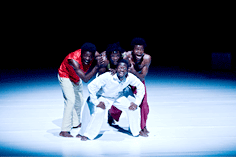
Europe’’s dance world has been increasingly focusing its attention toward Asian nations, first toward Japan with the 1980s butoh boom and then toward China, which boasts large pools of capital. Korea, too, despite being perceived as somewhat of an opportunist fishing in troubled waters, has asserted itself as an attractive market. This needs no further evidence than the fact that British dancers, for the sole reason that Korean and Japanese producers were present at the roundtable of an art market, eagerly jumped at the chance to venture into Asian territory.
On one hand, while "novel" contemporary art was dominating the European dance world, Asia was undergoing a radical change. Asian producers with decades worth of professional experience in international festivals and theater have been teaming up in their efforts to globalize Asian culture and build cooperative relationships. Despite being discontinued due to financial setbacks, Little Asia Dance Exchange Network (LADEN), a collaborative undertaking by producers from Taiwan, Singapore, Japan, Korea, Australia, and Hong Kong, showed that multinational cooperation was indeed possible, and the Association of Asian Performing Arts Festivals (AAPAF), founded in 2004, also developed a collaborative production and administrative funding system. To boot, various movements to secure public confidence and provide sufficient contentbased on rising demand have been observed throughout Asia. Though LADEN was regrettably unsuccessful because its appearance was premature in market terms, one could say that the Performing Arts Market in Seoul (PAMS), an organization created by the Korea Arts Management Service, and Asia-Pacific Dance Platform, created by the Hong Kong Arts Festival in 2008, are examples of the proactive and practical marketing of Asian performance arts.
|
|
|
| Bereishit Dance Company’’s Balance and Imbalance | A collaboration between New York’’s Dance Theater Workshop(DTW) and Seoul International Dance Festival entitled Kisaeng Becomes You |
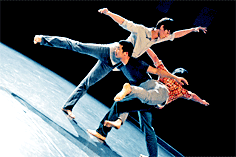
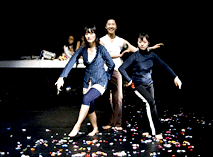
However, Asian status alone does not guarantee success for all. A small minority of artists, recognized by international strategists and equipped with a distinct local flavor, have a monopoly on the Asian performance arts market in Europe, where discrimination amongst Asian nations is severe. Ethnically Chinese nations such as Taiwan, Hong Kong, Singapore, and China itself are the forerunners, followed by their Southeast Asian counterparts, who are often their collaborators.
But Japan and Korea are removed from this equation. Japan alone displays a cohesive governmental, corporate, and even academic effort to create and insert mass amounts of cultural product abroad. Butoh, which took the world by storm, is a direct result of this. Korean dancers, on the other hand, penetrated the cracks and established themselves largely on an individual basis. Though Japanese dancers made up most of the Asian membership in European dance companies up until the late 90s, many of these positions have since been filled by Korean dancers. Though initially unnoticed due to the subtlety of its advancement, this is a clear sign that Hallyu (the Korean Wave) has already begun to put down roots in the realm of dance.
The Leaps and Bounds of Korean Dance
With the once-popular “trendy drama”—a genre of Korean television drama from the 1990s known for youth appeal, popular actors, trendy fashion, and simplistic approach to romance—as its impetus, Hallyu still holds fast to Korean television dramas, which have since become more refined and tasteful but remain a staple of Hallyu exports.
In the 1990s, the SeoTaeji wave overturned the world of popular music in Korea, contributing in critical ways to the diversification of mainstream Korean music. At the same time, the evolution of media and expansion of media channels effected a change in mainstream consumer patterns. Circa 2010, "idol"-oriented Korean pop culture caused a major international boom. Around this time, young and upcoming choreographers, influenced greatly by the preponderance of visual media, began to emerge on all fronts, each asserting their unique styles. Of course, it goes without saying that the quantitative increase in domestic infrastructuresuch as festivals, theater, and various other cultural projects offered countless opportunities for this generation to grow. As a result, more and more dancers were able to experience international stages and, in turn, veterans of the international stage were motivational forces for their juniors. This quantitative increase simultaneously provided more opportunities in Korea for foreign producers who had previously been indifferent to the idea of visiting Korea due to the geographical distance and high logistical costs,providing them with the opportunity to weigh Korea, Japan, and China against one another. Though it was already known that Korean dancers possessed exceptional skill, even those with no further knowledge began to "buy Korean." One Japanese producer and frequent visitor toKorea remarked after observing several Korean pieces in 2010, "Korea has exhibited a jaw-dropping amount of progress in the last 2–3 years."
In 2010, seven Korean dance companies toured festivals and theaters in four Spanish cities. Two choreographers among them received invitations to showcase their pieces the following year in Cuba, Spain, Poland, Mexico, the United Kingdom, Singapore, Indonesia, and the United States in 2012, and India, Venezuela, Uruguay, and Brazil in 2013. Following a 2012 guest performance in Israel, the first Korean piece to be nominated into the official program at CINARS 2012 (International Exchange for the Performing Arts) is now set to be performed in India, China, Romania, and the United States in 2013. Moreover, plans to introduce Korean dance as a special feature through photographs in Belgian festivals and theaters is currently underway in Belgium.
|
|
|
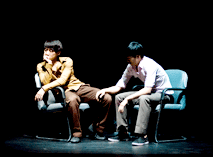
| EDx2 dance company’’s Modern Feeling | Choe Contemporary Dance Company’’s Argument |
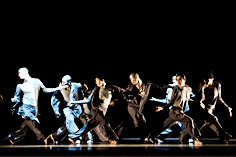
The Piece ItselfIs the Only Ticket to Victory
In the past, international exchange for Korean dancers occurred solely on mainstream stages, but these days the international exchange network for Korean dancers includes not only top-tier festivals but also smaller events and festivals as well as cooperative work and residencies throughout Asia, Europe, North America, and South America. And, of course, the sphere of activity has since been extended to the Arab world, Africa, and South America. The Ministry of Sports, Culture and Tourism, in conjunction with the Korea Foundation for International Culture Exchange (KOFICE), recently conducted a survey assessing Korea’’s international image abroad. The results showed K-pop and Korean soap operas to be at the forefront of Hallyu. Of the Asian respondents, 52.1%stated "physical attractiveness" as their reasonwhile 56.1% of those polled in Europe and America attributed their opinion to "novelty and uniqueness." According to the survey, these perceptions of Koreaprompted them tobuy Korean products, sample Korean food, and travel to Korea, in that order. Young fans in Ecuador, Colombia, and Indonesia asked Korean event staff working in those countries—the sole reason being that they were from Korea—for autographs. Raving about Korean B-boys, these fans continue to request, particularly on social media, regular appearances of Korean dancers.
Korean ballet, too, has already proven its worth in international concours such as those at Lausanne, Jackson, and Varna, and, unsurprisingly, it is not at all difficult to find Korean dancers in highly regarded dance companies around the world. Quietly but diligently, Hallyu dance has been holding its own. In addition to being a reservoir of excellent human capital, Korean dance has been putting the spotlight on pieces that embody identities and philosophies, be it the fruits of history or culture or the treatment of the individual in modernity. However, as demonstrated by the 2012 Performance Arts Survey, of 473 pieces performed a total of 3,999 times, most pieces are usually showcased at just a single festival before being retired, and only a handful of pieces attain significant recognition. Furthermore, it is hard to deny that only a very small percent of these pieces manage to contribute toward making Korean dance the next global trend.Still, the infrastructure responsible for aforementioned global and domesticshifts is still growing and evolving, and for the time being, "novel Asian contemporary art" still retains a great deal of popular appeal abroadwhile remaining a valid cultural movement to Koreans. In the coming years, international cultural exchange will be refined and diversified, and likewise, the market is sure to expand. On this account, it is imperative for the development of quality content that Korean society and government afford this movement the serious consideration and financial investment it deserves.
 PREV
PREV
.JPG)
.jpg)
.jpg)
.jpg)
.jpg)












;)


