





The Advance of K-Musicals, a Signal Flare for the Performing Arts Industry
[Trend] Why we pay attention to the "Korean Wave" in Performing Arts -- Industrialization
On the one hand, it’’s important to first establish that, in this writer’’s opinion, when existing plays or dances and other performing arts productions are invited and appear on stages abroad for the sake of cultural exchange, or when they fund a portion of their own production in order to participate in performing arts festivals, these activities fall into the category of pure art and foreign exchange. They cannot therefore be seen precisely as the advancement of Korean performances abroad, which usually have the specific goal of commercial success.
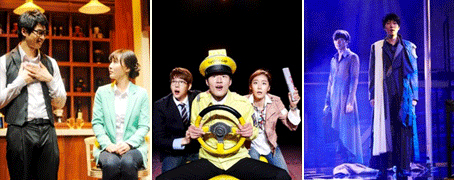
With the above premise, it’’s possible to say that certain productions, such as Palace(Gung/Princess Hours), 200 Pounds Beauty, Bballae(laundry), Run to You, Gwanghwamun Younga, Jack the Ripper, and other productions-adding up to about three or four a year after 2010-that were co-produced with Japan or carried out as tour performances can be seen as part of the full-fledged advancement of the K-musical abroad.
We’’re still in the early stages of a Korean Wave in the performing arts industry so it’’s difficult to analyze the effects, but here I lay out several proposals for how we might be able to prepare for the continuation of the K-musical.
|
|

The Limits of the Domestic Market
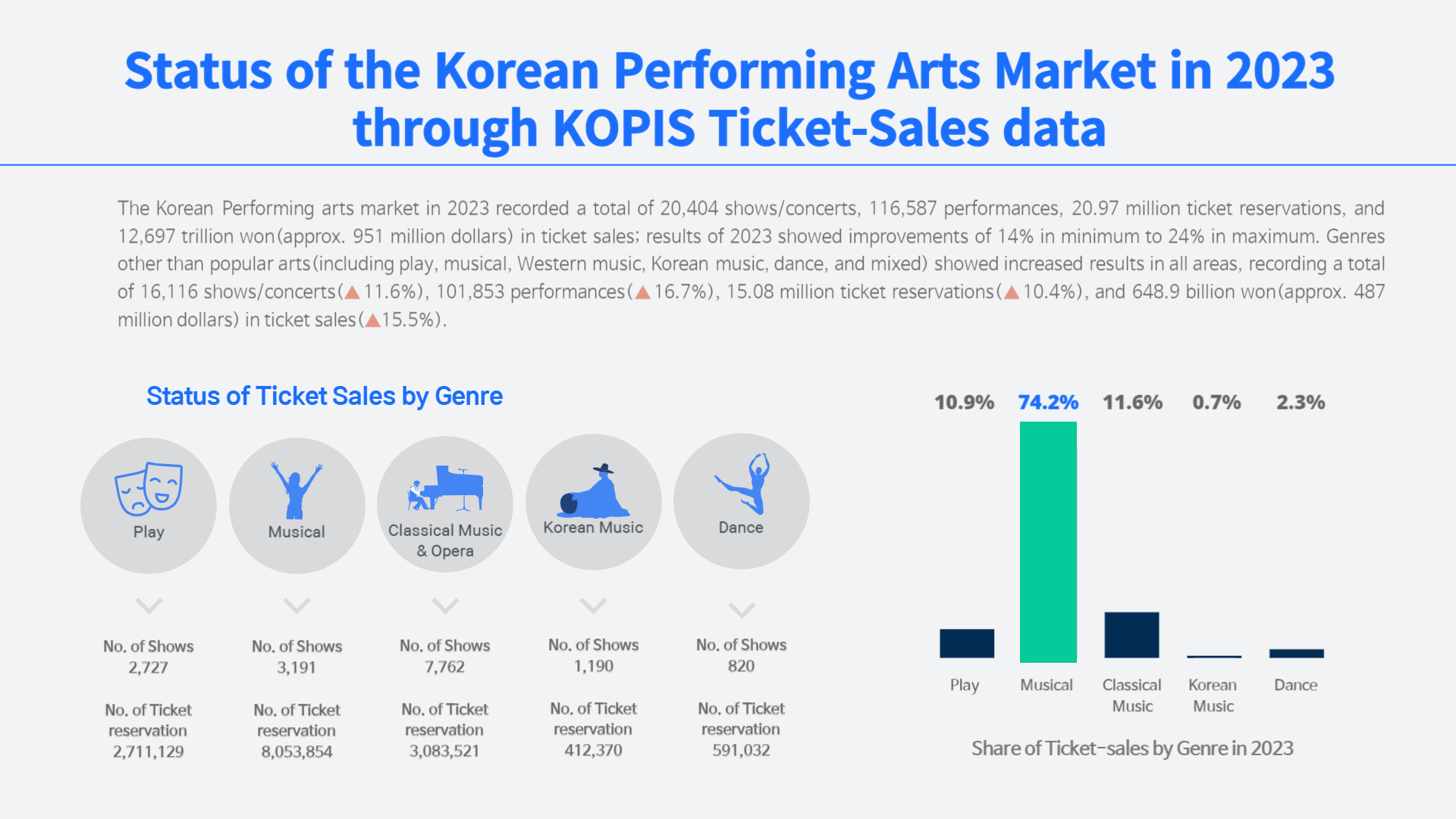
As of 2012 the size of the domestic musicals market is an estimated KRW 250 billion. This is the result of consistent expansion after the mid-2000s, which meant maintaining a yearly growth rate of 15%. Around 2017 the yearly market size is expected to be about KRW 500-600 billion. With the quantitative growth of the market, the distribution potential has also increased, with about four new large musical theaters opening in Seoul during last three years.
In terms of quality, Korean musicals have also developed rapidly in the last 10 years. Korean actors have proven their ability to hold their own on the world stage. The designers and technical staff are also talented enough to make it abroad even without the context of the original performance. These strengths are what enabled Korean musicals to attract Japanese fans during their domestic runs and also to succeed on tours to Japanese cities including Tokyo and Osaka. Nonetheless we are still relatively impoverished despite this potential for wealth, in that the demand for original Korean musicals is still relatively weak. For example, when we examine the 2012 popularity rankings of musicals on a website that handles over 70% of all domestic musical bookings, the most popular performance had sales of about KRW 25 billion and recorded about 230,000 audience members. That show was Wicked, a touring foreign performance. Korean musicals did not even make it into the top 10.
As everyone knows, with licensed musicals, about 10-18% of the ticket sales are transferred abroad as royalties. In the case of touring performances, even after paying an enormous performance guarantee fee, most contracts also require a significant cut of the total proceeds. Moreover, the market contains a limited population, meaning that there is a limited number of paying audience members even when you consider Seoul and the provinces together. Consequently, in the case of imported musicals, even the ones that look wildly successful on the outside have difficulty achieving profits of more than 10-15%. The reason is of course that the performance rights belong not to us, but to the licensor. This is one very compelling argument for the faster and wider dissemination of the Korean Wave of musicals.
The essence of the performing industry (to take it to the extreme) is in "the rights to profitable performances." In a situation where pre-production costs are only increasing, a profitable performance can attract more audience members in a single season and run for longer in different locations. Moreover, when the earnings far exceed the deficits of past failures, the production company can continue investing, even with several failed performances under its belt. The high added-value of success despite risk in the culture industry is what drives profit creation-it’’s a provable point.
For example, Wicked was able to carve out a permanent place in London and tour throughout Europe and Asia, including Korea, because it was so successful in attracting a constant stream of new audiences (mostly tourists) while on Broadway. And because it was successful, it was able to earn back profits equaling many more times its initial investment.
The Influential Effect of an Expanding Market Abroad
This writer believes that an expanding market for Korean musicals is in Northeast Asia, with an emphasis on Korea, China, and Japan. With the exciting and tentative presupposition that Korean-made musicals succeed in advancing to Japan and China, let’’s examine the sizes of the markets in each respective country.
Although China’’s musicals market has just begun to take its first baby steps, it has enormous potential. For a single production, a season of touring consists of about 8-16 months of touring China, with an emphasis on major cities such as Shanghai, Beijing, and Guangzhou. The seasonal sales of a single production can go up to about KRW 20 billion. There are more than three major markets that are about the size of Seoul alone, as well as multiple provincial markets in other cities in addition to that, where the production can get over 10 plays. According to a recent article, the ticket sales of performances that went to Beijing in 2011 was KRW 240 billion a year, more than the KRW 230 billion from movie ticket sales in the same year. With a focus on government-owned corporations that deal with culture, and as the infrastructure for performances expands through the construction of large-scale performance spaces in major cities throughout the country, it’’s highly possible that China will grow to become a major player in the performance market within the next five years, overtaking Broadway and West End. Moreover, China is set to become a huge tourist destination. It requires entertainment content for tourists to China who aren’’t necessarily Chinese.
|
|

On the other hand there is Japan, which has been the largest performance arts market in Asia for a while, with concerts, plays, musicals, and other productions in a market worth about KRW 1.7 trillion. At the same time there is concern over the slowing growth of this number one market. For us, the concern actually presents an opportunity. There are an increasing number of production companies attempting to revive traditional Japanese performances such as Kabuki Theater that have seen their market share drop,and they are now looking towards K-musicals for new and youthful content. Such companies were the ones that distributed and circulated the latest few Korean musicals in Japan. A single production that runs in Seoul and the surrounding provinces can expect to perform about 300-1000 times and achieve sales of about KRW 30-70 billion if it continues to tour throughout Japan and China. Even taking into account the cost of planning and development as well as opportunity cost, we can expect a profitability of over 30%. The figure is similar to that of a long-term show with an open run on Broadway, which can expect yearly sales of USD$60-70 million (KRW 70 billion) and profitability of over 30%.
The creators can benefit from this success through royalties. If we suppose that each creator receives about a 1-1.5% royalty on these sales, then no matter how high the royalties and creator fees are in the domestic market, they can receive far more than that with the previously described royalties. If one show succeeds, then the creators can live off the proceeds for many years, and the resulting wealth and fame will enable the creators to focus solely on good projects. Also, the very nature of performances means that many don’’t simply stop after a few times; they continue for years, and even tens of years. In such a case, recruiting talent will come naturally, and the production companies can also increase their opportunities for reinvestment.
The opportunity to create a multinational fund encompassing Korea, Japan, and China can act as a healthy engine for content production. An expanding market can drive this virtuous cycle for consistently creating quality pieces.
Issues to Resolve for the Production of High-Quality Cultural Content-The Significance of ‘Created by Korea’
Several institutions and foundations have developed "musical showcase"-type support systems for producing musicals for smaller theaters, but most of these systems are incubatory systems that dwell on the significance of developing new projects in and of themselves or focus on financial support for producing the performance rather than for the creation of original content such as the music and script. But the former produces relatively negligible results when compared to the way in which musicals are developed abroad: through significant investments of time and money and with multiple teams of writers over a long period of time. To emphasize once again: for a K-musical with Korean actors, it is imperative that “Created by Korea” shows from Korean creators and producers be put first.
From Beginning to End, the Story!
World-famous animation production company Pixar attributes its success not to new animation techniques or attractive characters but to the "story." This company has specific standards for evaluating the quality of a film, and from beginning to end, these standards are all about the story. To meet this aim, the company tirelessly invests both capital and its systems. The 22 Principles of Storytelling that Pixar developed through all of this has much to suggest to Korean audiences, many of whom tend to idly categorize stories as "entertaining" or "not entertaining," or see stories as "the end result of a creative process dependent on the artist or the writer’’s inspiration."
Or take, for example, Disney, which is unrivaled when it comes to movies and musicals. Disney caught on early and succeeded not only in creating original stories but studying and then recreating myths and ancient stories to appeal to universal sensibilities. The Lion King was inspired by Shakespeare’’s play Hamlet, and Mulan, Disney’’s 37th animation, was based on a legend from China, The Ballad of Hua Mulan. It goes without saying that these projects involve many different writers. Another important point about these projects is the skill involved in taking "tradition" and converting it into "popular culture." The same goes for music. There’’s an urgent need for long-term investment into creative sectors such as lyrical composition, in good music that adheres to the musical format.
|
|
Content Competition: There is Still a Chance to Win
There is no doubt that birthing a mega-musical such as Les Miserables, Cats, or The Phantom of the Opera, all of which have played for over 20 years and continue to play to audiences worldwide, is a lofty goal that is difficult to reach. And even on Broadway and West End where these musicals originated, after Wicked, which debuted 10 years ago, it’’s possible to see in recent years the traces of a depleting source of inspiration. Productions such as Spider-Man, Once, Newsies, The Bodyguard, and Charlie and the Chocolate Factory-based on pop music or movies from after the 1990s-are still carrying the torch. But future prospects for these musicals are dark, and it is doubtful whether they will ever grow to become megahits and continue to be beloved by audiences. And that is why eyes are turning to "Asian” subjects. With the rise of China and the potential size of the Chinese market, this new direction seems inspired by the prediction that "Oriental values" will become the new paradigm. China has already begun development on productions that take original Chinese content and use American and British systems to target the world market. One example is the planned development of a production that is based on a Chinese totem myth and involves the producers of the play War Horse, which took the US and the UK by storm. This is a clear indication that China’’s scope of influence is even bigger than anticipated.
|
|
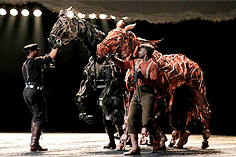
Of course I firmly believe that domestically there are already some among us who are looking into original sources. We can pride ourselves in and comfort ourselves with the fact that we have more extensive experience in the production of musicals than China, and a closer connection to Asian culture than American and British producers. But we have to examine the process and examine how effectively we are investing-both in terms of capital and support on the policy level. It seems that what is really needed, more than financial support for tours abroad, is support and investment for the creative process-that is, the process of creating the music and the story. The Korean Wave of K-musicals is just beginning to demonstrate its potential. It’’s a flare that signals to us: It’’s time to achieve success with the high-quality productions that make up the backbone of the performing arts industry.
 PREV
PREV
.JPG)
.jpg)
.jpg)
.jpg)
.jpg)












 began with the export of ..');)


