





Top5 Korean Arts Management News 2012: ’’In Progress,’’ Not ’’Complete’’
[Trend] Korean Arts Management Trend 2012
|
|
| |
| The Korean Artists Welfare Foundation | ||


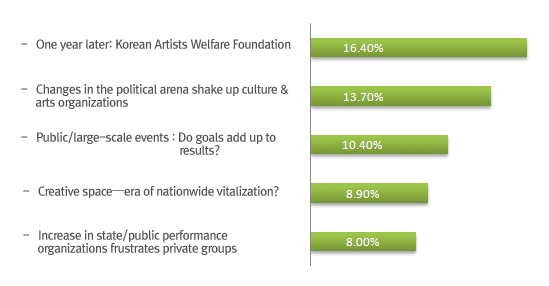
A reader survey of the top five arts management news issues of 2012 was conducted from November 22 until December 5. A total of 171 readers participated in this online survey conducted on the website of the Korea Arts Management Service and the weekly@Arts Management newsletter. The results are as follows:
|
| |
The Artists Welfare, amplification of attention for a change notice
The Korean Artists Welfare Foundation (KAWF), which was founded one year after the Artist Welfare Act was passed in the National Assembly, received the most attention of this year’’s top five arts management news issues. The much-spotlighted Artist Welfare Act was the epicenter of much debate, from its legislation until its promulgation into law, to the extent that "Artist Welfare Act Passes National Assembly" was selected as the most significant of the top seven arts management news topics for 2011. Debate raged fiercely on a number of issues, including the standards for defining the qualifications of and who may be acknowledged as an artist; the actual extent of occupational health and safety insurance benefits for artists; and how the size, structure, and budget of the KAWF would be determined. Starting in the near future, the KAWF will be formulating a business plan through exhaustive discussion and negotiation in order to create effective plans and revamp the system to improve the welfare conditions of artists, ranging from the establishment of legal protective measures for artists to qualification standards, occupational health and safety insurance, and mutual aid. Given the high degree of interest shown by not only those in arts management but also the greater Korean artist community, it appears that the foundation’’s future plans will be the focus of continued attention.
(See issue 182 for an article on this topic.)
|
| |
| The Korean Artists Welfare Foundation |

The high ranking of the second news topic seems to reflect the high degree of interest shown by those in arts management concerning changes in the culture and arts arena caused by changes in the political scene at the time of the survey, which was conducted shortly before the election. The interrelationship between politics and the arts was most likely not solely divulged through appointments of organization heads. However, based on the unavoidable dictum that the leader of an organization has a formidable influence on its direction, interest in who these leaders are cannot help but be high. This indicates the hopes and fears about what changes may come to the arena of arts management in 2013 as a result of external forces that can transform arts management organizations on a whim following the inauguration of a new president.
Nevertheless, there are still considerable rumblings about the extent of the actual results reaped from such events.
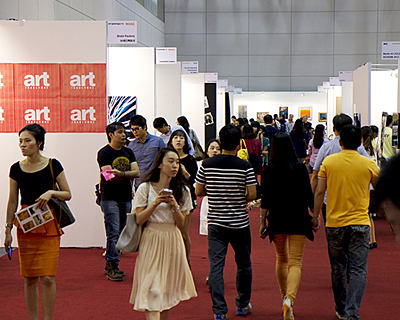
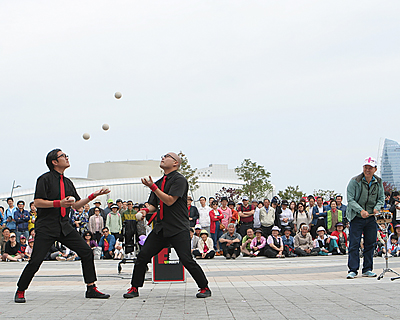
Just as in the past, this year witnessed many large-scale events. There were not only the various regional events like the Yeosu Expo but also the outdoor opera La Boheme and the American Ballet Theater’’s Giselle on the private end. Nevertheless, there are still considerable rumblings about the extent of the actual results reaped from such events. Neither events in the performance arts nor those in the visual arts—biennales, art fairs, etc.—are immune to such criticism. Although it did not make the top five arts management news issues of 2012, the management of biennales, which have recently drastically increased in number, is also a growing concern. Because of the particularly large number of biennales held this year, it was jokingly said that ’’presidents of regional self-governing bodies love biennales.’’ Among the approximately 200 biennales in the world, it is said that, including small-scale biennales, 20 are held in Korea(source: lecture by Professor Yu Jin Sang, Kaywon School of Arts & Design at the Arts Management Academy Conference ’’2012 Culture & Arts Settlement.’’)
Biennales have a number of advantages: they are biannual experimental attempts to address current art-related issues or problems, and their aim is to promote international exchange. However, despite the fact that it is an international event that requires a stable operations office as well as sufficient preparation time and many professional staff, biennales are too often run in an "act now, think later" fashion. This inevitably leads to obstacles from the start, including a short preparation period, insufficient professional consultation, short-term management that prevents the accumulation of know-how and experience, and personnel shortage. Now is the time for brainstorming and proactive strategies to solve the limitations and problems of domestic biennale management. (See columns in Issue 179and Issue 181)
|
| |
| Yeosu Expo 2012 |
|
| |
| The art fairs |
Review and Adjust
"Creative Space—Era of Nationwide Vitalization?" focused on the problems of creative centers built in unused space by local governments. Weekly@Arts Management has continuously published articles and dialogues about creative spaces. They are sprouting up in droves without long-term visions under the alibi of providing creative space for artists. Fundamental problems concerning output-centric management are also becoming increasingly apparent, including the emphasis on results within the short time of an artist’’s residency. There is a need to review and adjust management of creative spaces. (See the special features of Issue 133, Issue 134, and Issue 135) The fifth news issue selected was the concern that the growing number of theatrical productions by state/public organizations and groups is leading to a relative reduction in theatrical production activity by the private sector. In 2012, the National Theater of Korea produced Samguk Yusa Project, a series of performances based on a modern interpretation of the Korean classic Samguk Yusa. Not to be outdone, Myeongdong Theater and Namsan Arts Center produced a variety of works, including Don Quixote, A Midsummer Night’’s Dream, and One Blue Day. With public theaters increasingly creating their own productions in addition to simply acting as a venue for productions, the increased number of collaborative efforts between private theatrical troupes and individual artists with public theaters does have a positive aspect. However, the decrease in activity in the individual/private sector can lead to polarization in the production environment. A new relationship based on interdependency between the public and private theater as partners must be developed.In addition to the top five arts management news topics, "Basic Cooperative Act—A Strategy for Independence?" (6.6%) [reference: Policy System Q&A, Issue 188, and "Fandom—One Level Higher," (6.3%) both received over 6% (41 votes) of the total vote, followed by "KBS Orchestra Incorporated" (5.8%), "Hot Potato of the Art World: Artwork Transfer Tax" (4.8%) [reference: Column, Issue 166, "Architectural Design Out of Sync with Surroundings is Pushed through…Again?" (4.2%), "Foreign Art Directors in Performance Art—How Should They be Seen?" (3.9%), and "The Future of the Seoul Exhibition Hall of the National Museum of Contemporary Art, Korea" (3.8%). Although not on the list of survey topics, other issues were suggested as major happenings in the culture and arts field in 2012, including the ticket controversy of the musical Hero, the cancellation and delay of various Hi Seoul Festival performances because of Psy’’s performance at Seoul Square, the revitalization of and increased interest in village communities, concern about the debut of large production companies in the culture and arts field, and the establishment of a culture and arts educator system.
In general, the arts management issues selected this year are continuations of last year’’s issues. Considering the fact that some people felt there were few eye-catching issues and the fact that there are more negative than positive ones, it can be inferred that the arts management sector remains in difficult straits. Continued interest and effort will be necessary if we are to bring about the next stage of development in the issues raised in this survey, which served as a review of the events of 2012, and if we are to resolve the problems identified therein.
 PREV
PREV
.JPG)
.jpg)
.jpg)
.jpg)
.jpg)












.gif','A reader survey of the top five arts management ne..');)


