





Understanding Korean Traditional performing arts
[Trend] 2012 Mook magazine of ’’TheApro’’:Rediscovering Traditional Korean Performing Arts
|
| |
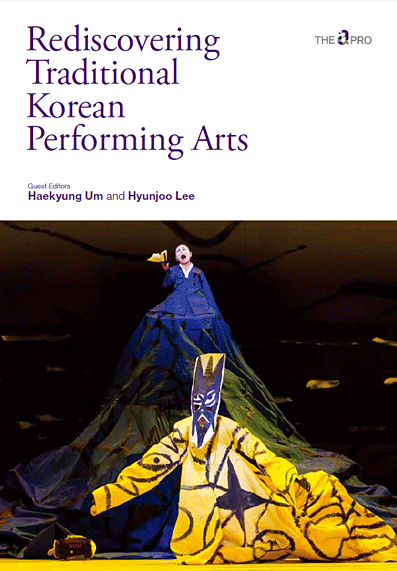
As the readers will find out from this volume, understanding traditional performing arts is not just about discovering a historical and cultural past. It is also about understanding how artistic practice continues to evolve in a new era and changing environment. The positions and roles of traditional Korean performing arts are open to various interpretations and applications, with their audiences and stage expanding globally and intercultural artistic exchange increasing. For example, as seen on the cover of the book, the pansori opera Mr.Rabbit and the Dragon King was a product of a collaboration between the Korean National Changgeuk Company and the German stage designer Achim Freyer to bring together a traditional Korean musical drama and an avant-garde theatre style developed by Bertolt Brecht. In many ways, it exemplifies how different artistic traditions across time and borders can meet to create something entirely new. Most importantly, individual and collective artistic endeavours, made by musicians, dancers and actors, are the key driving force in the creative process of Korean performing arts, by simultaneously rediscovering their traditional roots and opening up to new ideas.
Rediscovering Traditional Korean Performing Arts
This volume explores traditional Korean performing arts in historical and contemporary contexts. Various genres of music and dance performed in public, private and ritual settings, different functions, aesthetics, producers and consumers are examined from both local and global perspectives. Authored by ten scholars who specialize in Korean music and dance, this book’’’’s overall scope and range of specific topics are broad and varied. At the same time, there are several common themes and overarching issues which are pertinent to the traditional Korean performing arts as understood from the vantage point of the 21st century. In this volume, each author focusing on their particular area of expertise to help us better locate traditional performing arts in modern Korea.Table of Contents
Korean Traditional Music : A Bird’’’’s-Eye View, Byong Won Lee
The European Reception of Gugak : Performing Korean Court Music in Vienna, Austria, Sang-Yeon Sung
The Way of Pungnyu : Musical Interactions at Private Venues in Seoul, from the Late 18th to Late 19th Centuries, Sung-Hee Park
Music in Korean Shaman Ritual, Simon Mills
How Do We Know About the Dances of Korea’’’’s Past?, Judy Van Zile
Entertaining Dances at the Joseon Court, Jungrock Seo
Tradition and Innovation in Changgeuk Opera, Andrew Killick
Performing Pansori Musical Drama : Stage, Story and Sound, Haekyung Um
To One’’’’s Heart’’’’s Content :Baramgot and Reclaiming Creative Space in Gugak, Hilary Vanessa Finchum-Sung
Canonic Repertoires in Korean Traditional Music, Keith Howard
In his article, ’’Korean Traditional Music : A Bird’’s Eye-View’’, Byong Won Lee outlines some of the key features of traditional Korean music, focusing on its performance styles, timbre and texture. ’’The European Reception of Gugak : Performing Korean Court Music in Vienna, Austria’’ is Sang-Yeon Sung’’’’s case study of a 2005 Korean court music concert held in Vienna. It illustrates how overseas concerts are strategically programmed and delivered by the National Gugak Center for their international audiences. The third article in this volume, ’’The Way of Pungnyu : Musical Interactions at Private Venues in Seoul, from the Late 18th to Late 19th Century’’, by Sung-Hee Park, is an historical account of the music-making activities in the late Joseon period. She discusses the interrelationships between the dynamics of social and economic change and the significance of music-making and listening as leisure by the middle and upper classes in the capital Seoul. Simon Mills’’ article ’’Music in Korean Shaman Ritual’’ describes and analyses the characteristics of Korean shaman tradition and the central roles of music in various ritual procedures and contexts and in particular the way in which the percussive rhythms shape the performances.
The next two articles are concerned with traditional dance forms. Judy Van Zile’’’’s article ’’How Do we Know About the Dances of Korea’’’’s Past?’’ discusses how we could interpret various iconographic depictions of Korean dance forms and styles as found in archeological and historical records. The second dance article is ’’Entertaining Dances at the Joseon Court’’ by Jungrock Seo who describes how, in contrast to the common image of an austere Confucian dynasty, the Joseon court supported a considerable number of court dances for entertainment purposes.
The next two articles are concerned with traditional musical dramas. Andrew Killick’’s article entitled ’’Tradition and Innovation in Changgeuk Opera’’ explicates the historical and social context in which changgeuk was created at the turn of the 20th century as the first theatrical genre to be performed on indoor stages. Haekyung Um’’s article ’’Performing Pansori Musical Drama : Stage, Story and Sound’’, explains how the concept and practice of pansori staging has evolved while the pansori stories and themes were limited to a canon of five pieces with numerous emergent variations and adaptions. In her case study ’’To One’’s Heart’’s Content : Baramgot Reclaiming Creative Space in Gugak’’, Hilary Finchum-Sung discusses the creative processes adopted by the new Korean ensemble Baramgot.
The last article of this volume, ’’Canonic Repertoires in Korean Traditional Music’’ is Keith Howard’’s critical examination of the canonization of traditional Korean performing arts. Focusing on samulnori ensembles established in the 1970s, he examines the creative process and evolution of samulnori to become a Korean musical canon in a very short period of time.
Download 2012 Mook theApro
 PREV
PREV
.JPG)
.jpg)
.jpg)
.jpg)
.jpg)












.gif','’’’’’’’’’’’’’’’’’’’’’’’’’’’’’’’’’’’’’’’’’’’’’’’’’’..');)


